Today’s topic: Hispanic Serving Colleges Grant Lawsuit.
The Hispanic Serving Colleges Grant Lawsuit is at a critical point in early 2026, as federal courts weigh the future of education funding based on diversity.
The lawsuit, officially named State of Tennessee v. U.S. Department of Education, is based on whether or not it is constitutional to fund grant monies based on percentages of enrolled students.
The events of late 2025 have resulted in the Department of Justice refusing to make a case for funding, causing a massive reprogramming of more than $350 million in discretionary grant monies.
This has resulted in a crisis for several hundred colleges, which are now forced to come up with a budget for research and student services.
In this article, we will elaborate on the following:
- The legal arguments for the Hispanic Serving Colleges Grant Lawsuit.
- The impact on university budgets and programs for the 2026 fiscal year.
- How the Supreme Court’s decision on affirmative action relates to this case.
- The legislative actions being taken by Congress to reinstate the money.
What Are Hispanic-Serving Institutions (HSIs)?
In order to understand the Hispanic Serving Colleges Grant Lawsuit, one must first understand the federal criteria for these schools.
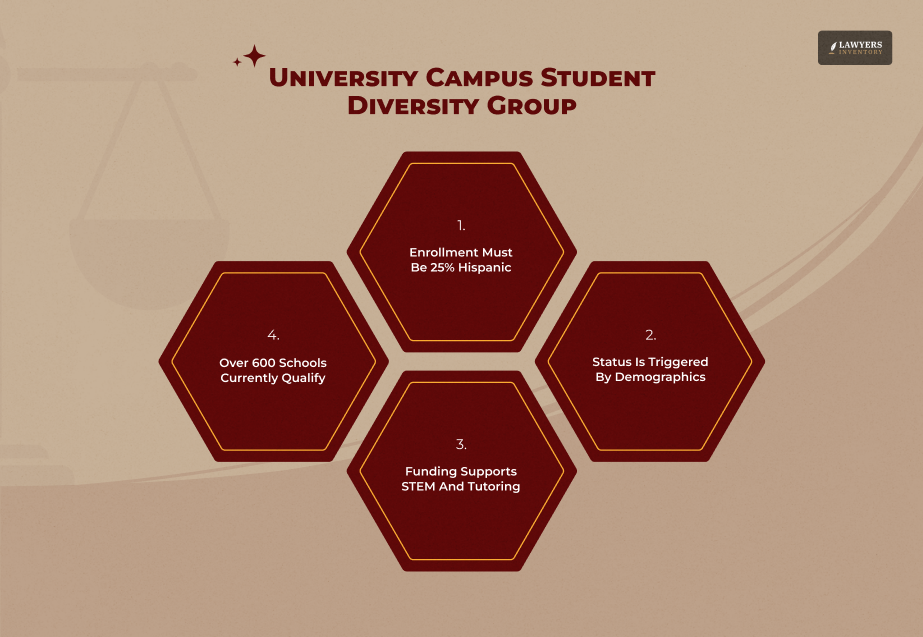
Unlike other minority-serving institutions, becoming a Hispanic-Serving Institution is based on a set percentage enrollment.
The 25 Percent Enrollment Rule
According to the Higher Education Act, a college or university can become a Federal Funding for Hispanic Colleges recipient as long as at least 25% of the college’s full-time undergraduate enrollment is Hispanic in ethnicity.
This criterion does not take a college’s mission into account.
A college can become an HSI due to demographic changes in the student body, which is why there are over 600 HSIs in the United States (Source: HACU.net).
Purpose Of Federal Aid
The purpose of these Minority Serving Institution Grants was to increase graduation rates and improve the quality of education within these institutions that predominantly serve Hispanic students.
These schools traditionally receive significantly less funding on a per-student basis than elite private schools.
Overview Of The Hispanic Serving Colleges Grant Lawsuit
However, the Hispanic Serving Colleges Grant Lawsuit is not a local case, but rather a strategic attempt to redefine federal government spending authority.
This segment will discuss who is propelling this case and the current 2026 status of the case.
Plaintiffs And The Tennessee Filing
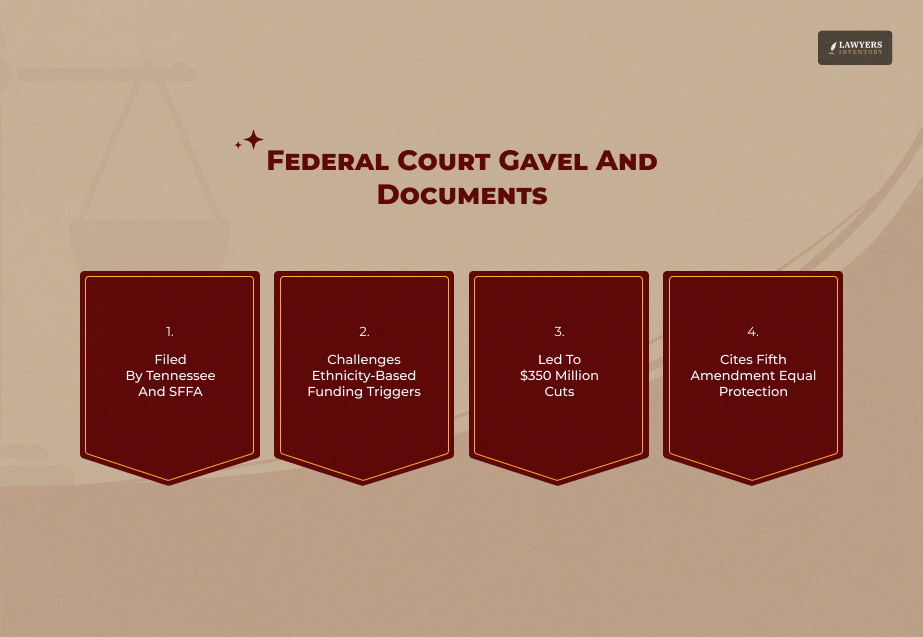
The Hispanic Serving Institutions Lawsuit was instituted by Tennessee Attorney General Jonathan Skrmetti and the plaintiff group Students for Fair Admissions (SFFA).
The lawsuit was filed in the US District Court for the Eastern District of Tennessee, as reported by TN.gov.
The plaintiffs claim that the 25% threshold is an arbitrary ethnic quota that excludes schools with a high population of low-income students who simply do not have the right mix of ethnicities.
The 2026 Funding Crisis
As of March 2026, this lawsuit has already caused substantial financial harm. In late 2025, the US Department of Education announced that they will not award any new discretionary funds until this lawsuit is resolved.
This has caused a $350 million crisis for the current fiscal year, with Chico State University in California losing over $3 million, forcing them to cancel graduate fellowships and equipment upgrades (Source: Hechinger Report).
Arguments Behind The Lawsuit
The Hispanic Serving Colleges Grant Lawsuit is based on recent Supreme Court decisions on race and ethnicity in education. The legal arguments used in this lawsuit are similar to those used in the 2023 affirmative action ruling.
The Supreme Court Precedent
The Supreme Court Precedent used by the Plaintiffs in the Hispanic Serving Colleges Grant Lawsuit is SFFA v. Harvard.
The Plaintiffs believe that if racial balancing is unconstitutional in college admissions, then racial balancing in federal grants is also unconstitutional.
This HSI program forces colleges to recruit ethnic groups to maintain their federal funding. This is patently unconstitutional, they believe.
The Government’s Position
In a surprising turn of events, the Solicitor General notified Congress in mid-2025 that they would not be defending the 25% enrollment requirement in the HSI Grant Lawsuit.
This means they believe these provisions of the HSI program probably violate the Fifth Amendment of the U.S. Constitution.
This Due Process Clause of the Fifth Amendment of the U.S. Constitution has given the Plaintiffs an advantage in 2026.
So what were the Legal Arguments here?
Here’s the gist of it.
1. It mirrors SFFA v. Harvard logic.
2. Opposes race-based government spending.
3. Claims grants incentivize racial balancing.
4. DOJ refused to defend programs.
Impact On Colleges And Students
The Hispanic Serving Colleges Grant Lawsuit is already having a significant effect on the day-to-day running of many American universities. The loss of these Minority Serving Institution Grants is being felt by all students, regardless of their ethnic background.
Terminated Programs And Services
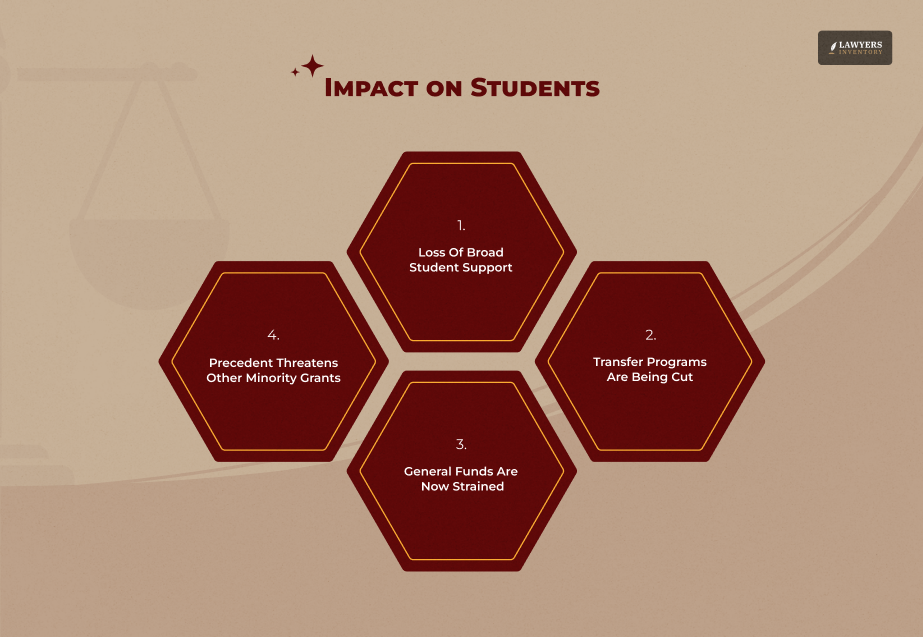
The programs terminated due to the Hispanic Serving Colleges Grant Lawsuit are not exclusively for Hispanic students.
A good example is the Bridges to Baccalaureate program, which provided research pay for all low-income transfer students at several California-based schools.
Because of the funding freeze, which is set to take place in 2026, these programs are now being terminated or shifted to general university funds, which are already overstretched.
Risks To Other Institutions
Experts are warning of a domino effect, whereby other programs, like those for Asian American and Pacific Islander-Serving Institutions, will be terminated. This would be a complete withdrawal of ethnicity-based federal funding for higher learning.
Federal And State Laws
The Hispanic Serving Colleges Grant Lawsuit is based on several aspects of American law. It deals with both aspects of Congressional spending and the individual rights of students and faculty.
The Higher Education Act
The main law under dispute is the Higher Education Act of 1965, specifically Titles III and V. This allows the Secretary of Education to grant funds to strengthen institutions that serve a large number of Hispanic students.
The Hispanic Serving Colleges Grant Lawsuit, however, claims that Congress went beyond their authority when they based their spending on racial grounds.
Read Also: University of Metaphysical Sciences Lawsuit and the Saga of Predatory Litigation (Or, Is It?)
The Fifth And Fourteenth Amendments
The Hispanic Serving Institutions Lawsuit, at the state level, deals with the Fourteenth Amendment’s Equal Protection Clause.
At a national level, it deals with the Fifth Amendment’s Due Process Clause. The federal government should be colorblind when it comes to spending taxpayer dollars.
The universities of Tennessee are being disadvantaged because they are not allowed to receive millions of dollars, simply because their Hispanic students are fewer than 25%.
Read Also: MSU Chemical Exposure Lawsuit Explained – Health Risks & Legal Impact
FAQs On The Hispanic Serving Colleges Grant Lawsuit
The current legal climate has also raised many questions for the general public about how colleges receive aid. The FAQs provided here are intended to answer the most pertinent queries about the Hispanic Serving Colleges Grant Lawsuit and its immediate repercussions.
The Department of Education removed this funding because of the Hispanic Serving Colleges Grant Lawsuit, as it is now legally unsafe for them to provide funding based on racial quotas, which the DOJ will no longer defend.
Some members of Congress are attempting to reinstate this funding through new budget bills. But, there is still a massive legal problem for any ethnic-based spending because of the Hispanic Serving Colleges Grant Lawsuit.
Experts believe that it does not, as HBCUs are not based on ethnic percentages, but rather on their historical mission.
Leave A Reply






Hung Jury vs. Mistrial: What Is The Difference And Why It Matters
Read More
NarodniyDimUkraina: An Overview Of The Kyiv-Based Brand Preserving Ukrainian Craftsmanship
Read More
What Is A Mistrial? Legal Definition, Causes, And What Happens Next
Read More
What Is A Sequestered Jury? Legal Definition, Process, And Everything You Need To Know
Read More
What Is A Hung Jury? Legal Definition, Causes, And What Happens Next
Read More
0 Reply
No comments yet.