Summarize using AI





Prompt copied. Paste it into Gemini.
Today’s topic: Social Security warning.
For millions, Social Security isn’t just money – it’s how they stay afloat in retirement. It is about their financial stability when they do not have a steady source of income.
However, the Office of the Inspector General (OIG) recently stated that there’s been a sharp spike in impostor fraud targeting government programs. According to their official website, here’s what the official notice stated:
“The Office of the Inspector General (OIG) has recently received reports of telephone scammers using real SSA and OIG officials’ names – many of which are publicly available on our websites or through an online search.”
These schemes don’t want cash – they want access to bank accounts and IDs. A single email can open the door to years of saved income.
Criminals use fake calls and messages, often mimicking trusted voices – to gain trust. Once inside, they move fast – stealing funds before you even notice – a gap that leaves many exposed.
In this blog, we will talk about the following things:
- What is the new Social Security warning about?
- Red flags to look out for in these social security scam warnings for retirees.
- How scammers use technology for these activities.
- How to secure your SS benefits?
- What to do if you are scammed?
Therefore, keep reading!
Social Security Warning For Retirees: The Anatomy Of The New “Statement Scam”
The most prevalent current threat involves fraudulent emails or letters claiming to provide access to your “Social Security Statement.”
Scammers know that retirees prioritize tracking their benefits, and they exploit this interest to create a false sense of urgency.
How The Scammers Operate
Here are some of the ways in which scammers are targeting people in the Social Security scam:
- Impersonating Real Officials: To appear legitimate, criminals now use the names and even photos of actual SSA employees found on public websites.
- Official-Looking Documents: Fraudulent letters often feature the agency’s official letterhead and are stamped with phrases like “Official Document” or “Official Government Communication” to bypass a reader’s skepticism.
- Phishing for Data: The primary goal is usually to convince you to click a link to “verify” your identity, which leads to a fake login page designed to steal your Social Security number and bank details.
About “Slam The Scam”
“Slam the Scam” is an essential consumer protection campaign mainly carried out by the Social Security Administration that aims to educate the public about government imposter fraud and stop it. (Source: Social Security Administration)
Usually, it is a fraudulent phone call, text, or email from a person posing as a government official that starts these scams.
Scammers may even cunningly say that your Social Security number is involved in a crime, or they may threaten that you will be arrested instantly if you do not pay a “fine.”
In order to make you comply, they create a very pressing situation and insist that you pay via gift cards, wire transfers, or cryptocurrency that is untraceable.
It is highly advised that you keep in mind to never receive any threat or demands for these particular forms of payment from real government agencies.
The best thing to do if you get suspicious communication is to hang up the phone right away and report the matter at oig.ssa.gov.
Besides, the most successful method of “Slam the Scam” is to be vigilant and share these Social Security warning signs with others.
4 Critical Red Flags Every Senior Should Know
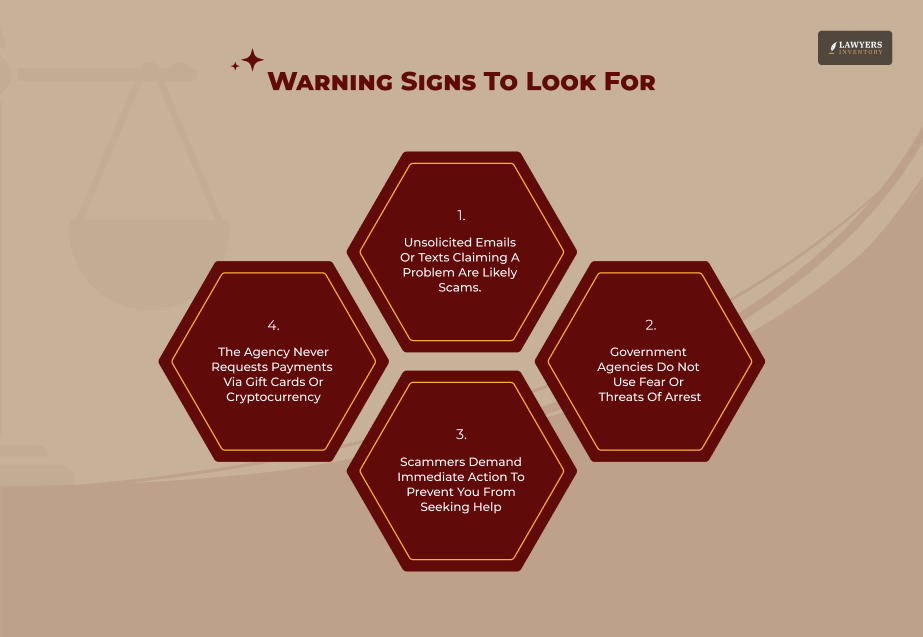
The SSA has identified four key signs that a communication is a scam, according to AOL. If you encounter any of these, stop and think scam first.
Unexpected Contact From A “Reputable” Source:
The SSA generally contacts you by mail regarding account issues. An unsolicited email or text claiming there is a “problem” with your Social Security number is almost certainly a fraud attempt.
Threats Of Immediate Harm Or Legal Action:
Legitimate government agencies do not use fear as a primary motivator. Scammers may threaten you with arrest, the suspension of your SSN, or the freezing of your bank accounts.
Pressure To Act Immediately:
Professional fraudsters want you to act before you have time to consult with family or friends. They may claim that “immediate action” is required to prevent a legal investigation.
Specific, Untraceable Payment Requests:
The SSA will never ask you to pay a debt or fee using:
- Retail gift cards.
- Wire transfers.
- Cryptocurrency (Bitcoin, etc.).
- Cash or gold bars.
Emerging Tactics: AI And “Safe” Government Accounts
As technology evolves, so do the methods used by impostors. For instance, in 2024 and 2025, two specific developments have made these scams harder to spot:
1. The U.S. Supreme Court Scam
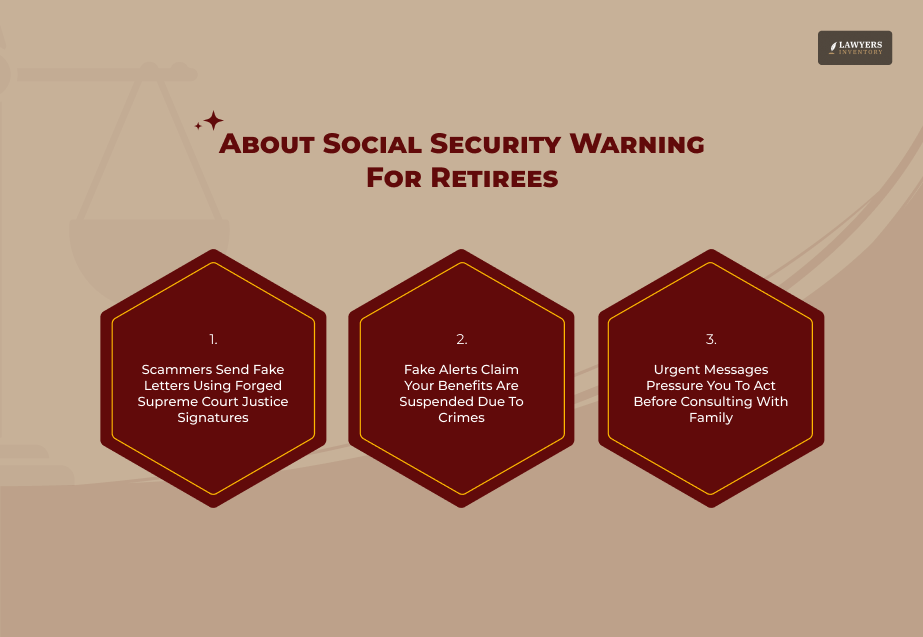
Firstly, a newer, highly elaborate version of the impostor scam involves letters falsely representing the U.S. Supreme Court.
Additionally, these documents claim you are a suspect in a federal investigation and may even feature forged signatures from high-ranking officials like Chief Justice John Roberts.
They often instruct victims to transfer their money to a “safe government account” to protect it from being frozen – a request no real agency would ever make.
2. AI-Generated Personalization
Secondly, Artificial Intelligence now allows scammers to produce thousands of personalized messages daily.
These AI tools can mimic the professional tone of government agencies perfectly. As a result, this makes it nearly impossible to spot a “fake” through grammar or spelling alone.
Proactive Defense Against Social Security Warning: How To Secure Your Benefits?
“Don’t believe anyone who calls you unsolicited from a government agency and threatens you – just hang up,” said Inspector General Ennis, the Inspector General for the SSA. (Source: OIG, Social Security Administration)
Waiting for a scam to happen is not enough. You can take active steps today to harden your defenses.
1. Create A “my Social Security” Account
One of the best protective measures recommended by the SSA is to set up your personal account at ssa.gov/myaccount. By claiming your account, you prevent scammers from creating one in your name.
Furthermore, having an active account can trigger alerts if anyone tries to change your direct deposit or address information.
2. Verify Independently
If you receive a suspicious message, do not use the contact information provided in that message. Instead:
- Hang up or close the message.
- Look up the official number for the agency independently (e.g., calling 1-800-772-1213 for the SSA).
- Speak with a verified representative to confirm if the communication was real.
Read Also: What Is OASDI? A Complete Guide To Your Social Security Benefits
Social Security Scam Warning: What To Do If You’ve Been Targeted?
In conclusion, if you think you’ve been scammed or shared personal data, act fast – don’t wait. Here are the steps that you can take:
- Report the Scam.
- Freeze Your Credit.
- Monitor Your Accounts.
The Social Security Administration emphasizes the fact that awareness beats everything else. Besides, scammers win when people stay silent or turn their backs.
You’re not alone – spreading this info helps protect neighbors too. Keeping your benefits safe starts with one person making a choice.
Leave A Reply




Power Stick Deodorant Recall FDA: Your Complete Safety Guide
Read More
Is It Legal To Use True People Search? What Are Its Restrictions?
Read More
Case Is Being Actively Reviewed By USCIS – Meaning And Timelines
Read More
Refund Risk Under Income Tax Demand Notice Section 143(1) Summary Adjustments [A Complete Legal Assessment]
Read More
2026 Rules For The Legal Age Of Marriage In India
Read More
0 Reply
No comments yet.