
Today’s topic: Mens Rea and Actus Reus.
For a crime to be held against someone, the state is obliged to provide evidence of criminal intent and criminal actions.
As per common law, this means evidencing both the mental state and the physical act for criminal responsibility. In case a defendant had no involvement in the commission of the crime or didn’t intend to do the illegal act, they might still be found guilty of a crime.
According to the Model Penal Code (MPC), criminal statutes delineate the required elements of an offense. These are the things that a prosecutor needs to prove in order to convict a person of a crime.
They consist of the culpability (mens rea) and the conduct, which is part of the forbidden conduct (actus reus). The Mens Rea and Actus Reus conjunctions work together to indicate the elements of most criminal offenses in the U.S. legal system.
In this article, we will break down the following things:
- What is Mens Rea and Actus Reus in criminal law?
- What are their elements?
- How can a lawyer help you with criminal intent?
Therefore, if these are a few things that you want to know, keep on reading this blog till the end…
What Is Mens Rea And Actus Reus In Criminal Law?
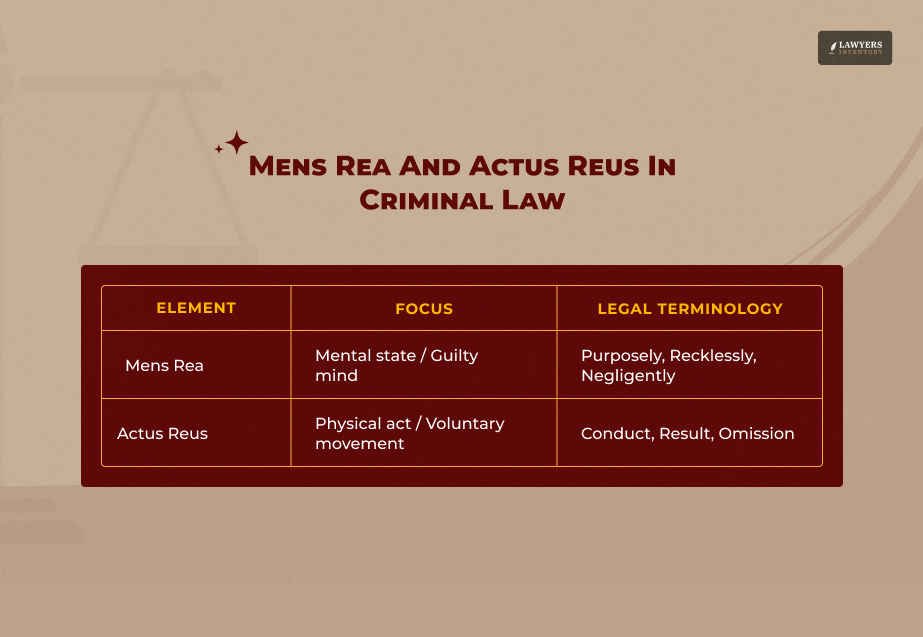
Mens rea, or “guilty mind,” is a cornerstone of criminal law. It zeroes in on a person’s mindset when they commit an act.
“Not every action that breaks the law is done with deliberate intent to do wrong. So, mens rea helps determine whether someone had foul play in mind or just made an honest mistake.
It is like separating those who accidentally tripped into murky waters from those who dove right in, knowing what was underneath,” says West Palm Beach Criminal Lawyer Douglas Leifert of Leifert & Leifert.
Understanding this concept can significantly sway how charges are approached and penalties are calculated.
Understanding Actus Reus In Criminal Law
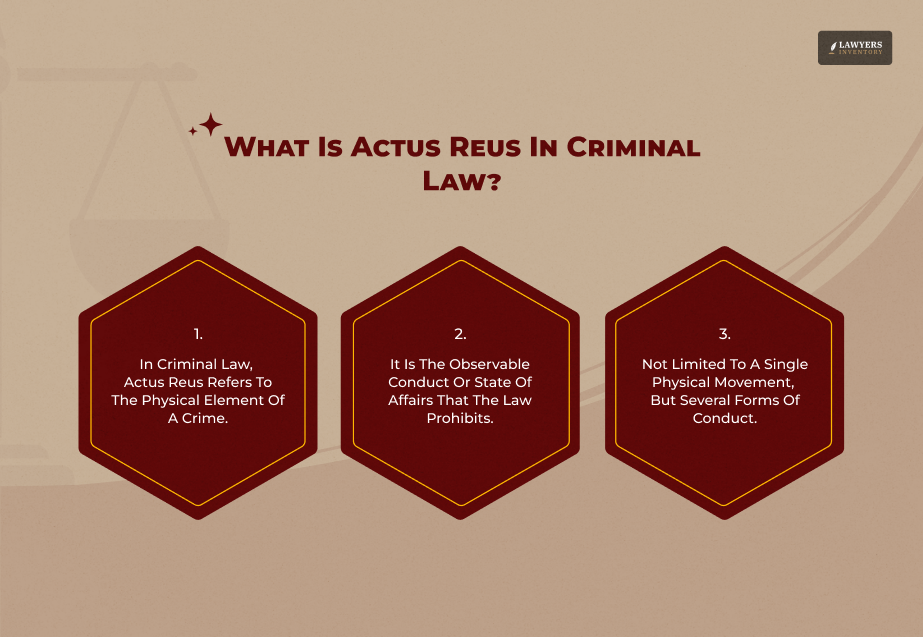
Actus reus, as a legal term, translates to “guilty act,” which captures any action or its lack in many cases. Whether picking up a bracelet at the mall without paying for it or running a red light, these acts are all considered breaches of the law.
Considering the fact that there are several other acts that society forbids, the law also prohibits them. Therefore, these acts are inclusive of actus reus. Of course, there are different subtypes of these criminal acts that constitute the actus reus.
For example, attempted crimes that contribute to the commission of the crime, as well as substantial steps taken with the intent to cause harm or injury to someone, fall under this criterion. Any interruption or change of heart is considered while passing a judgment!
There is also a conspiracy to commit the crime, so an individual falls under this criterion. When you support someone else or engage in a criminal act, even if the crime does not occur, the court will consider the intent.
Solicitation is another subtype involving enticing or urging someone else to commit a crime. Lastly, being an Accomplice means actively helping someone else commit a wrongful deed.
Types Of Actus Reus
A criminal act doesn’t always have to be carried out to completion. “Inchoate crimes” are those that only involve the preparation of a criminal act. Such are the cases of:
- Attempted crime.
- Conspiracy to commit a crime.
- Solicitation.
- Accomplice.
For instance, burglary is the illegal entry into a building with the intent to commit a felony or theft.
Nevertheless, if you were trying to break in but couldn’t get past the alarm, it might be considered an attempt to burglarize. The punishments for attempted offenses may be as severe as those for the commission of the crime.
LII further states that “Actus reus includes only a voluntary affirmative act, or an omission (failure to act), causing a criminally proscribed result.”
A conspiracy is an agreement between two or more individuals to commit a crime. The mutual agreement and the intention to obtain a criminal result constitute a crime when a participant commits an overt act. It is a criminal offense of conspiracy if the crime is never carried out or if one person changes their mind.
Asking someone else to do the illegal act is criminal solicitation. For instance, asking someone else to bring illegal drugs across the border is not drug trafficking. However, it may be drug trafficking solicitation.
Understanding Mens Rea In Criminal Law
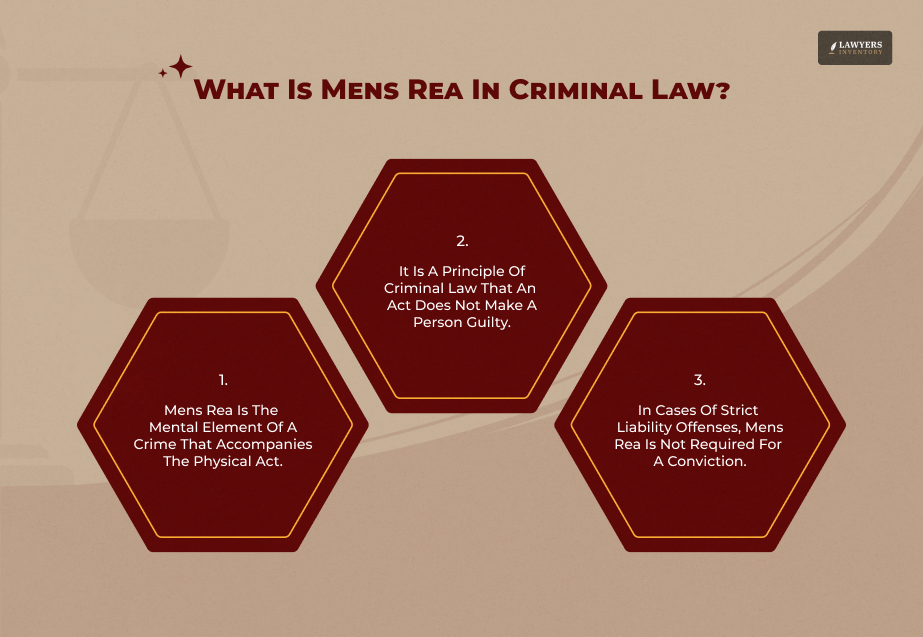
When evaluating the term Mens Rea, we understand that it concerns the mental state and its capacity to form criminal intent. In terms of intent, we mean negligence, recklessness, the ability, and the knowledge you need to possess.
Furthermore, the mens rea is quite subjective when we evaluate the crime because the causal intention plays an important role. This is especially so because the accused’s state of mind must be the focal point of the case.
Let’s not forget the necessary criminal intent and liability required to commit a crime. Additionally, strict liability offenses combine the various requirements necessary to form the intent to commit a crime.
According to Legal Information Institute, “Mens rea is the state of mind statutorily required in order to convict a particular defendant of a particular crime.”
There are specific mens rea based on which the crime and its type are evaluated. A fundamental element in criminal law, mens rea is the intent behind running a red light to hurt someone or reaching the hospital when your family member is admitted there as an emergency.
Simultaneously, in this act, if you hurt someone, your mental state and their reaction to this situation should also be considered!
Types Of Mens Rea
“Mens rea allows the criminal justice system to differentiate between someone who did not mean to commit a crime and someone who intentionally set out to commit a crime,” according to FindLaw.
Mens rea is not just about outright intent. The law slices it finer by categorizing mental states into several types, which can indeed affect case outcomes. First off, there is “purposely,” where someone dives into an action fully aware of its illegality with a goal in mind.
Then you have got “knowingly”—this is when a person understands their actions are wrong but goes ahead anyway. Next up is “recklessly,” characterized by blatant disregard for clear risks. A notch lower is “negligently,” where someone misses the warning signs that they are veering toward illegal turf.
Tucked away from these classic categories are strict liability offenses like statutory rape. Here, innocence about certain specifics—like age—does not exempt one from culpability.
Each flavor of mens rea shapes how severely the law might come down on a defendant, highlighting why grasping this concept is crucial.
Navigating Intent With Legal Expertise
It is quite daunting for any individual if they face criminal charges! Intent plays an important role in any criminal case, especially when the accused is judged by their intent. The terms Mens Rea and Actus Reus reflect on the conceptualization of intent.
For a skilled attorney, it is quite easy to decipher and interpret these complicated legal terms. They can then move towards evaluating the actions and then proving that it lacked the criminal intent to prove you non-guilty.
Additionally, there are also chances of reduced charges or the potential of achieving a complete acquittal. These generally depend on the understanding of the attorney and their proving of the same in the court.
Specifically, it is important for the lawyer to understand the intent of the act and its implications, both long-term and short-term.
Particularly in Florida, collaborating with a knowledgeable West Palm Beach Criminal Lawyer could be essential. Their expertise includes navigating through local laws and tailoring defense strategies based on understanding both mens rea and actus reus as they apply to your specific situation.
Read More:
- Tulsa Criminal Attorney: Your Freedom Deserves the Best Protection
- Chicago Federal Criminal Lawyer: Expert Legal Defense Solutions
Leave A Reply






Hung Jury vs. Mistrial: What Is The Difference And Why It Matters
Read More
NarodniyDimUkraina: An Overview Of The Kyiv-Based Brand Preserving Ukrainian Craftsmanship
Read More
What Is A Mistrial? Legal Definition, Causes, And What Happens Next
Read More
What Is A Sequestered Jury? Legal Definition, Process, And Everything You Need To Know
Read More
What Is A Hung Jury? Legal Definition, Causes, And What Happens Next
Read More
0 Reply
No comments yet.