The MSU chemical exposure lawsuit is a major lawsuit. It involves the safety of students within the university.
In early 2025, a former student of Michigan State University decided to take the university to court for $100 million.
The thyroid cancer that the former student suffered from was a result of exposure to harmful pesticides during her research work.
The MSU chemical exposure lawsuit, therefore, shows that the students lack the right training in safety gear.
In the following article, we are going to discuss the details of the case and the current status of the case as of March 2026.
Currently, the lawyers are studying the safety records of the university from the year 2008 to 2011.
After all, harmful substances take over a decade to develop in the human body.
In this article, we will elaborate on the following:
- The background of the plaintiff and her specific cancer diagnosis.
- The hazardous chemicals named in the litigation and their known health risks.
- Federal and state safety laws governing university research laboratories.
- The potential legal implications for academic institutions across the United States.
What Is the MSU Chemical Exposure Lawsuit About?
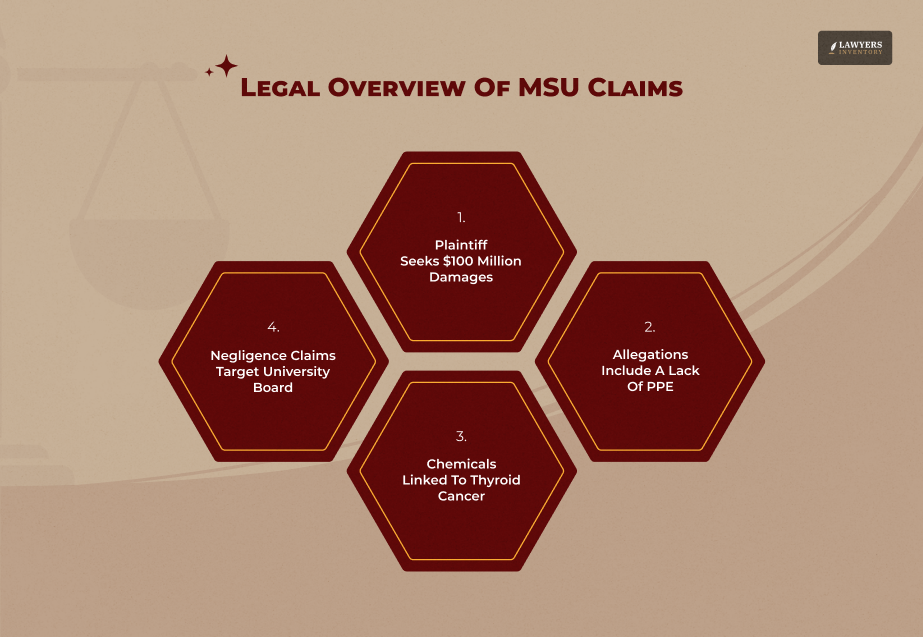
The MSU chemical exposure lawsuit is based on the charges of gross negligence and failure to provide a safe work environment. These led to life-altering health problems in the students.
Background Of The High-Stakes Claim
The MSU chemical exposure lawsuit claims that the university prioritized research results over the health of its students. Michigan State University went against safety regulations in its horticulture department.
Thus, this led to direct and repeated contact with the herbicides and pesticides containing harmful chemicals.
Impact on University Safety Standards
The MSU chemical exposure lawsuit will hopefully change the safety standards of universities in the United States.
If the court rules in favor of the plaintiffs it would set a guideline on how to treat research assistants in the United States.
The Plaintiff – Who Is LingLong Wei?
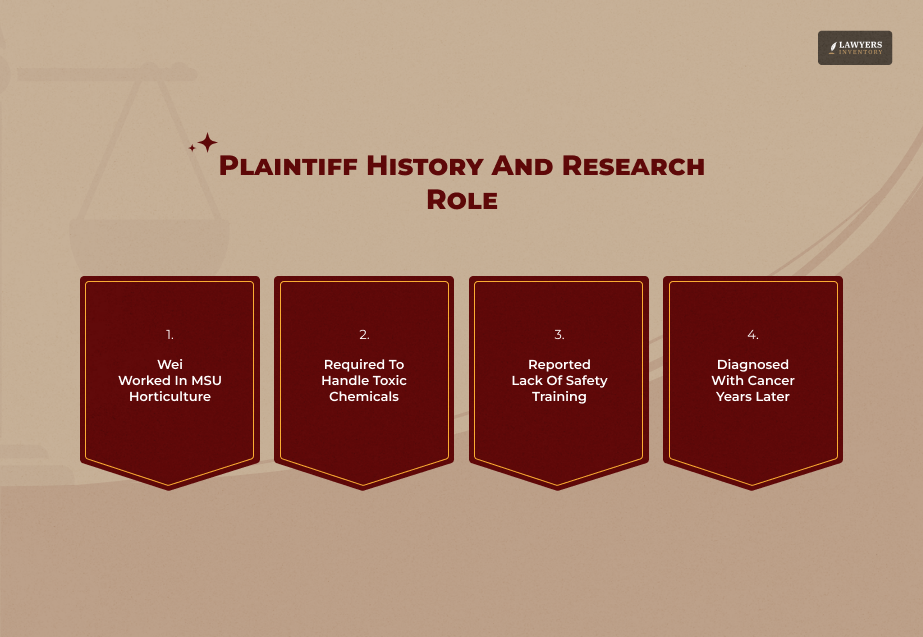
The LingLong Wei student who is at the center of this lawsuit is a former graduate student at Michigan State University. She worked as a research assistant in the university’s horticulture program from 2008 to 2011.
Health Outcome And Diagnosis
In 2024, LingLong Wei was given a terrible diagnosis: thyroid cancer. This was after her stay at Michigan State University.
In her lawsuit over chemical exposure at MSU, she describes how she had to undergo multiple surgeries to remove her thyroid gland. She now has to live with hormone injections for the rest of her life to stay healthy.
Claims Of Gross Negligence
The lawsuit over chemical exposure at MSU claims that LingLong Wei had asked to be provided with safety equipment on multiple occasions but was denied. Her requests were dismissed as mere anxiety about the chemicals.
Case Details – Wei V. Michigan State University Board Of Trustees
The case of Michigan State University chemical exposure has some specific legal filings that state the university’s negligence.
These details are important to know to track the case’s progress through the Michigan judicial system.
Case Details:
- Plaintiff: LingLong Wei.
- How the Complaint Started: Wei filed a notice of intent to sue after linking her 2024 cancer diagnosis to her 2008-2011 MSU research work.
- Court: Michigan Court of Claims.
- Case Number: Pending (filed as a notice of intent in late 2024/early 2025).
- Ruling: Currently in pre-trial discovery; no final ruling has been issued.
- Judge: Case assigned to the Michigan Court of Claims presiding bench.
Allegations In The Lawsuit
The MSU chemical exposure lawsuit mentions various hazardous substances handled daily by the plaintiff. These are common in agricultural research activities and need proper handling mechanisms to remain safe.
Exposure To Hazardous Chemicals
The lawsuit mentions various toxins handled by the plaintiff. These include paraquat dichloride, glyphosate, and oxyfluorfen. These have shown a high potential of causing endocrine disruption and cancer in human beings (Source: Michigan Advance, 2025).
Wei states in her lawsuit that she used these on plants without a barrier between the toxins and her skin.
Lack Of Safety Equipment And Training
The plaintiff in the MSU chemical exposure lawsuit states that she was not given any safety training or Personal Protective Equipment (PPE) such as respirators or gloves. The lawsuit states how she mixed these hazardous substances in a poorly ventilated area.
Chemical Risks And Scientific Context
The science behind the MSU chemical exposure lawsuit is crucial. The chemicals in the lawsuit are heavily regulated by the EPA.
These chemicals are toxic to humans and the environment.
Pesticides And Herbicides Risks
Paraquat is one of the most toxic herbicides currently being used in American agriculture. Although glyphosate is not as toxic as paraquat, it has already caused thousands of lawsuits over possible non-Hodgkin lymphoma.
The MSU chemical exposure lawsuit claims that the chemicals are very dangerous. Thus, they should have been handled with professional-grade equipment.
Federal Safety Standards (EPA/OSHA)
Federal laws require all employers to provide “Hazard Communication” training to their employees. Universities are required to maintain a Safety Data Sheet (SDS) for all chemicals used on the campus. If MSU failed to provide the SDS, they may have violated the OSHA regulations.
Legal Framework: Federal And State Laws
The MSU chemical exposure lawsuit uses state negligence laws and federal environmental laws. The purpose of these laws is to make sure that an organization does not “cut corners” on the health of humans.
Michigan State Tort Law
The state of Michigan requires that the plaintiff prove that the defendant had violated their “duty of care.”
The MSU chemical exposure lawsuit claims that the defendant had the duty to care for the students. Gross negligence is the act of “showing no substantial concern as to whether an injury results.”
The Michigan Right to Know Act
This law parallels federal regulations that require employees to be aware of the chemicals they use.
Universities must identify the containers and train their employees on the specific health hazards of the substances they use. Not following these procedures is the main idea of the MSU chemical exposure lawsuit.
The Hidden Danger: Symptoms If The Lawsuit Never Took Place
If the MSU chemical exposure lawsuit was never filed, there could be many safety infractions that would never be exposed. This could lead to even more “silent” diseases in future students.
Undiagnosed Health Issues
Chemical exposure can cause symptoms that people attribute to everyday illnesses. This can include fatigue, skin rashes, and headaches. If not for the MSU chemical exposure lawsuit, students might not realize that these are related to their work in the lab until it is too late.
History Of Toxic Tort Cases
There have been many cases throughout history in which companies have tried to conceal toxic dangers from consumers.
For example, in the Kemner v. Monsanto case, there was an issue with spills that could affect an entire community.
This is similar to the MSU chemical exposure lawsuit in that it forces an influential organization to face consequences for its environmental actions.
Read Also: University of Metaphysical Sciences Lawsuit and the Saga of Predatory Litigation
Expert Tips And Safety Best Practices
Students and researchers should take active steps to protect themselves in laboratory settings. The MSU chemical exposure lawsuit serves as a stark reminder that you must be your own strongest safety advocate.
- Always demand the Safety Data Sheet (SDS) for any chemical you handle.
- Never work with pesticides or herbicides without wearing the required PPE.
- Report any lack of safety training to the university’s environmental health office.
- Document every time a supervisor asks you to perform a task without proper protection.
FAQs – Understanding Your Rights
The MSU chemical exposure lawsuit is raising numerous questions among student researchers and university staff. Some of these questions are addressed in the following paragraphs.
The case is based on toxic torts and gross negligence of the university for providing poor working conditions.
Yes, students can receive workers’ compensation if they are diagnosed with a work-related illness.
Firstly, you need to consult a doctor immediately if you suspect that you have been exposed to toxins in a university setting. Also, you need to note all instances when you handled chemicals without proper equipment.
Leave A Reply






Nunaturals Sweetener Recall FDA Warning – Complete Legal And Safety Guide
Read More
FDA Highest Concern Cake Recall Salmonella – Safety Alert And Guide
Read More
Shein Lawsuit: Copyright, Consumer Claims, And All Major Legal Battles
Read More
Girl Scouts Cookies Lawsuit Explained – Safety Claims And Legal Truths
Read More
Complete Guide To The Affirm Lawsuit And Legal Action
Read More
0 Reply
No comments yet.