Summarize using AI





Prompt copied. Paste it into Gemini.
Quick Answer: Gerrymandering Meaning

Gerrymandering is the practice of changing the shape of electoral districts for a political party's benefit and that of its supporters. In this method, politicians change the lines of the districts to influence or manipulate the outcome of the elections. It is done so because, if the district lines are changed as a result, the politicians could win more seats and so have control over the outcome of the elections even in case where their opponent got more of the votes.
Gerrymandering means deliberately drawing election district boundaries to benefit one political party. This tactic creates an unfair advantage for a specific party, group, or individual.
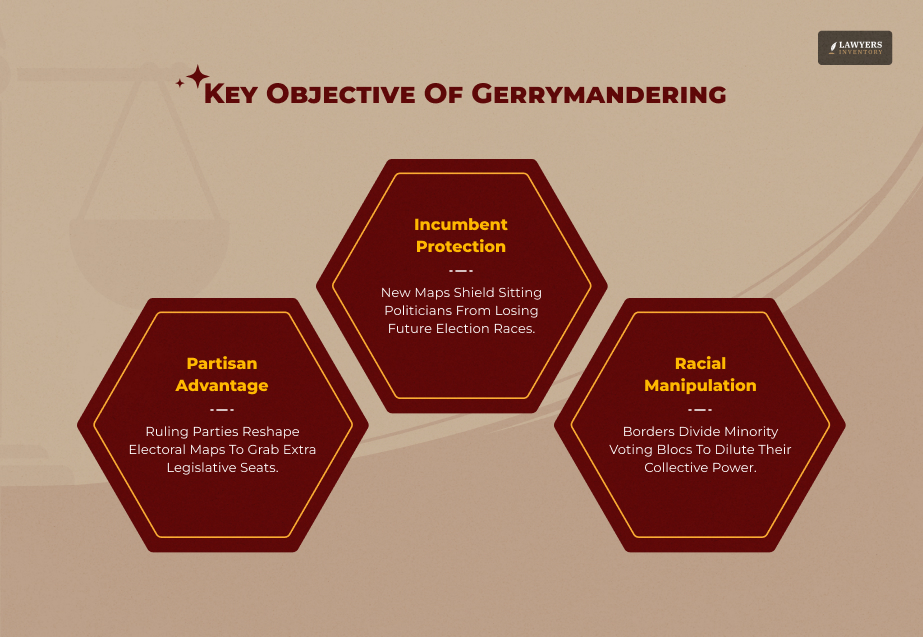
Today, political leaders most often employ two techniques called cracking and packing. Modern gerrymandering falls into three broad categories: partisan, racial, and malapportionment.
To know more about gerrymandering meaning, keep reading!
Gerrymandering Meaning: What Does The Term Actually Mean?
According to the definition from Cambridge, gerrymandering is basically “an occasion when someone in authority changes the borders of an area in order to increase the number of people within that area who will vote for a particular party or person.” [Source: Cambridge Dictionary]
Gerrymandering twists voting district lines for political gain. This practice completely ignores the core goal of fairly reflecting the local population.
These distortions occur specifically during the redistricting phase, when authorities update the country’s voting maps every 10 years following the U.S. census.
Redistricting itself remains a common and essential process. Because populations shift over time, district boundaries must change to keep representation equitable. However, politicians gerrymander when they abuse this process simply to maintain their own power.
This practice affects more than just U.S. Congressional maps. It includes any unjustly drawn boundaries for state legislators, city council members, school board representatives, and county commissioners.
Origin Of The Term Gerrymander: Where The Word Came From
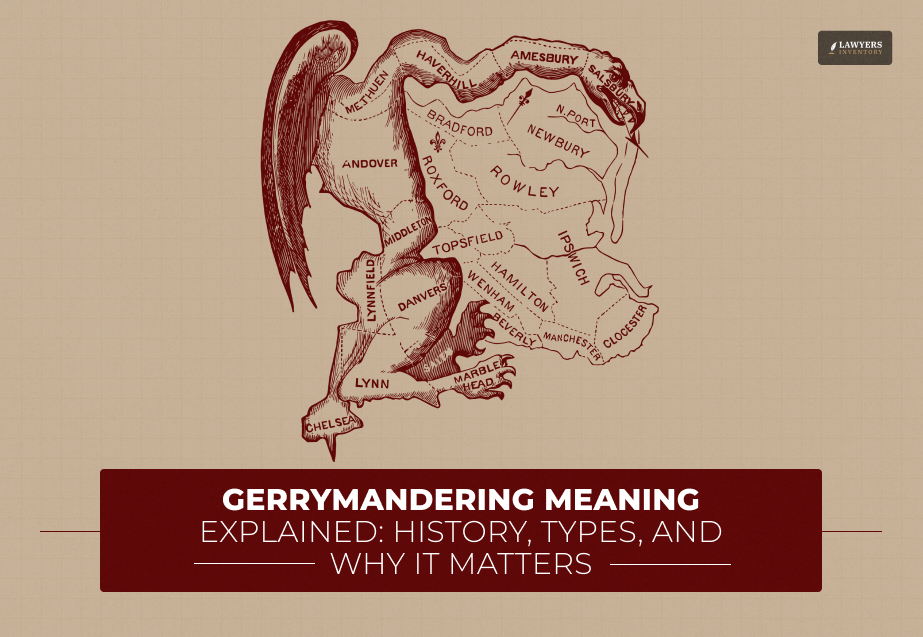
The term gerrymandering came from one specific map and one real person. In 1812, Massachusetts Governor Elbridge Gerry signed off on a state senate district.
This new district featured a highly unlikely and distorted boundary.
The Boston Gazette subsequently published a satirical caricature of the distorted district. The newspaper coined the term “Gerry-mander” by combining the governor’s last name with the word “salamander.” [Source: Britannica]
Other newspapers quickly reprinted the caricature, officially launching the term into popular culture.
However, politicians manipulated voting districts long before the word even existed. In the 1780s, Patrick Henry tried to redraw Virginia’s map for the very first congressional election.
He specifically designed the map to force his political enemy, James Madison, out of Congress. This historical maneuver occurred decades before Gerry’s map gave the practice its permanent name.
The Techniques Behind Gerrymandering
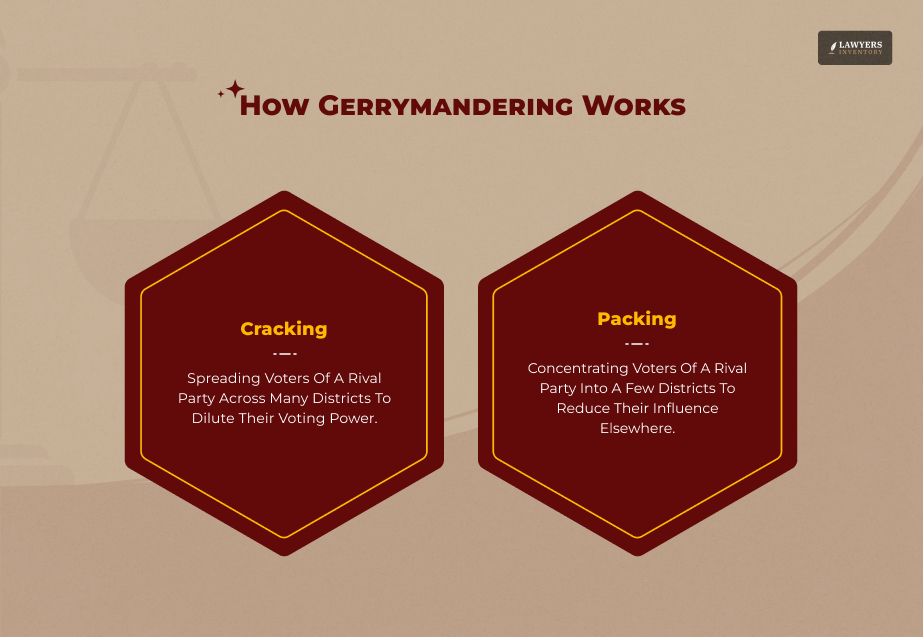
Mapmakers generally rely on cracking, packing, or a mix of both. Understanding these two core techniques makes gerrymandered maps much easier to spot.
Cracking
Cracking splits a specific group of voters across multiple districts. Because of this split, their numbers never add up to a majority in any single zone. A group that could have won one district easily gets divided into small pieces. This dilutes their political influence everywhere.
Packing
Packing works the opposite way. Instead of splitting a group up, mapmakers pack those voters into just one or two districts. The packed group wins those few districts by huge margins. This feels like a victory, but it actually wastes votes. It leaves fewer voters from that group to influence surrounding districts.
Mapmakers often combine both methods on the same map to produce the best overall result for their party.
The Different Types Of Gerrymandering
Not all gerrymandering looks the same. The specific type affects how courts view the practice.
Partisan gerrymandering occurs when politicians draw maps to benefit one political party over another. News stories discuss this form most often.
Racial gerrymandering happens when mapmakers use race as the main factor to draw district lines. They do this to dilute minority voting power or to sort voters by race.
Malapportionment is a separate issue. It means drawing districts with unequal populations. A vote in a small district ends up counting for more than a vote in a crowded district. Modern laws require equal populations to prevent this.
Is Gerrymandering Legal?
The legal status depends on the intent. Under current U.S. federal law, partisan gerrymandering is legal. However, racial gerrymandering is unconstitutional. Proving racial bias in court has become much harder recently.
The Supreme Court ruled on this in the 2019 case Rucho v. Common Cause. The ruling removed federal courts from policing partisan maps entirely.
Later, a 2026 ruling in Louisiana v. Callais narrowed how plaintiffs can prove racial claims under the Voting Rights Act.
Ultimately, the word describes a political practice rather than a permanent legal status. I have covered the legality of gerrymandering in my previous blog – do check that out for an in-depth study.
Does This Happen Outside The U.S.?
The specific term is American, but the underlying practice occurs worldwide.
India calls its equivalent process delimitation. An independent Delimitation Commission handles the process rather than elected politicians.
Even so, Indian journalists now borrow the word “gerrymandering.” They use it to describe politically motivated boundary changes, such as recent disputes in Assam and Jammu & Kashmir.
And that is not all.
According to a recent publication from The Hindu, this particular word “has entered Indian polity with Indian National Congress leader Gaurav Gogoi accusing Prime Minister Narendra Modi of using the delimitation exercise as a tool for “gerrymandering.””
How To Recognize Gerrymandering
You do not need a textbook to spot a manipulated map. A few practical signs can help you identify it in the news.
Odd shapes offer a good clue. A district that snakes across a state to connect specific voters deserves a second look. However, some odd shapes are legitimate. They may follow a winding river or keep a historic town together.
Lopsided results provide a much stronger signal than shape. Consider a state where one party wins 55% of the total vote but takes 80% of the legislative seats. That map warrants skepticism.
The mapmaker matters immensely. When one political party draws lines without independent oversight, the risk of gerrymandering rises.
Finally, watch for mid-decade redraws. Redistricting normally happens just once a decade. A state that updates its maps outside that cycle is highly unusual.
Gerrymandering Meaning: Why This Matters Now
Gerrymandering is essentially the act of manipulating the drawing of a district map to favor one party. The result is biased representation that has influenced politics in the USA for years.Understanding these principles will help you keep track of the redistricting story in the political news during each time there is an election.
Leave A Reply






Do You Pay Taxes On Lawsuit Settlements? IRC Section 104 Explained
Read More
Non-Disparagement Clause Explained: Requirements, Enforceability, And What Changed Recently
Read More
Best Practices For Successful Trademark Registration
Read More
Understanding Your Rights: A Guide To The Legal Process
Read More
How To Clear A Bench Warrant Without Going To Jail: A Legal Guide
Read More
1 Reply
Is Gerrymandering Legal? What Latest Ruling Means for States
August 27, 2026 at 5:58 am
[…] the part most people don’t talk about: the gerrymandering legal question really splits into two separate tracks, and they don’t follow the same rules […]
Reply