Summarize using AI





Prompt copied. Paste it into Gemini.
Listen to this article
Quick Answer: What Does Pro Bono Mean

Pro bono is derived from the Latin phrase pro bono publico, meaning “for the public good.” In legal practice, it refers to free legal services provided voluntarily by attorneys to individuals or organizations that cannot afford to pay. Pro bono work is not a discounted rate, a contingency arrangement, or a sliding-scale fee. It is genuinely free professional legal representation - though clients may still be responsible for certain court costs. The term carries a specific professional meaning in law that distinguishes it from all other forms of reduced-cost legal help.
Fifteen million Americans face court proceedings every year without a lawyer. Not because they do not want one. Because they cannot afford one. The legal system that is supposed to protect their rights is, for most of them, financially out of reach.
Pro bono legal services exist to close that gap – partially, imperfectly, but meaningfully. Yet the term itself is widely misunderstood.
People confuse it with contingency fee arrangements. They assume it means any form of discounted legal help.
They do not know who qualifies, how to find it, or what it actually costs them.
What Does Pro Bono Mean?
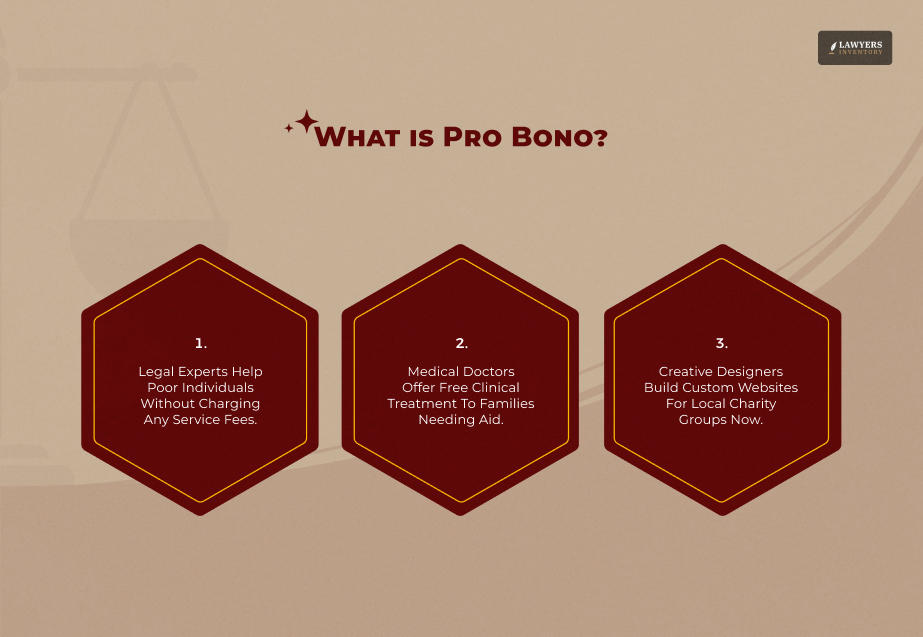
Pro bono was common even among lawyers from ancient times to use pro bono publico in their practice.
This maxim, which meant “for the benefit of the public,” signified a basic idea, i.e., that lawyers should serve the needs of society and not merely those of individuals who are rich and can pay for such services.
At present, one can say what pro bono essentially means: legal services that are not expected to generate any monetary gains.
This usually means that the lawyers are rendering free-of-charge legal assistance which is normally not available for a certain reason, like the client can’t afford it.
The services are offered voluntarily – the lawyer is not compelled by law to take the case, but chooses to do so as part of their professional responsibility. [Source: Purdue Global Law School]
Rule 6.1 of the ABA’s Model Rules for Professional Conduct states that lawyers have a responsibility to voluntarily work at least 50 hours of pro bono legal services each year. This standard is aspirational rather than mandatory at the federal level – attorneys are not disbarred for failing to meet it.
However, the professional and ethical weight behind it is significant. All 50 states and the District of Columbia acknowledge the need for lawyers to engage in pro bono service.
And they have included their own version of ABA Model Rule 6.1 in their own Rules of Professional Conduct or adopted the ABA’s rule entirely. [Source: Legal Information Institute]
Does Pro Bono Actually Mean Free?
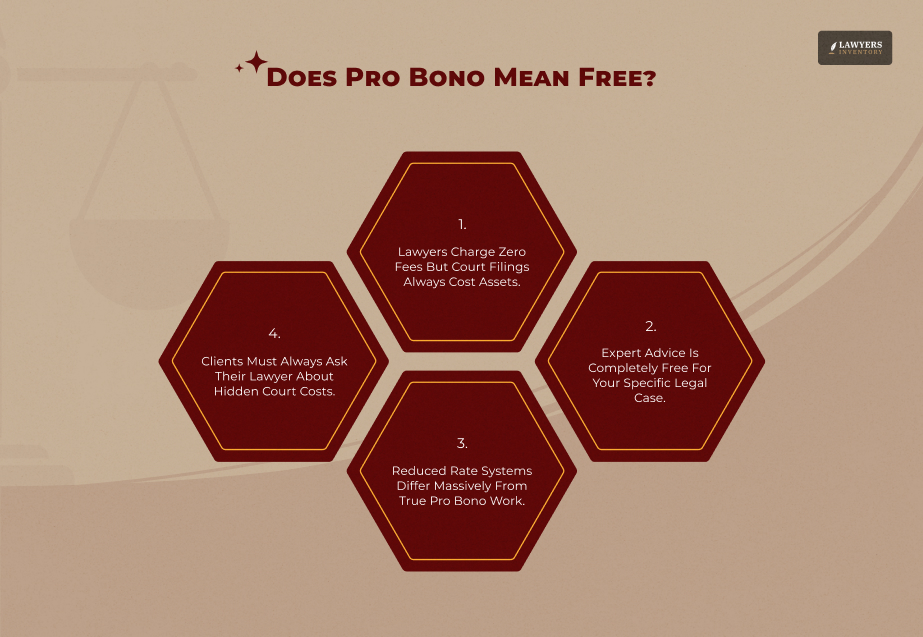
This is the question most people genuinely need answered.
While pro bono attorneys do not charge fees for their legal services, clients may still need to pay court costs and filing fees unless they qualify for fee waivers.
In practice, this means the attorney’s time and professional expertise costs you nothing. But the machinery of the court system – filing fees, transcript costs, service of process fees, and in some cases expert witness fees – may still apply. [Source: FindLaw]
Whether those costs are covered depends on the specific program, the attorney, and the jurisdiction. Some pro bono programs absorb all associated costs. Others do not.
Before assuming that pro bono means every aspect of your legal matter is free, ask explicitly what costs, if any, you will be responsible for.
What pro bono definitively is not: a contingency fee arrangement, where the lawyer takes a percentage of any award; a sliding-scale or reduced-rate representation; or a “low bono” arrangement, which involves significantly discounted but not zero-cost services.
These are distinct structures that are frequently conflated with pro bono in everyday conversation – and the distinction matters practically.
The Justice Gap That Makes Pro Bono Necessary
Understanding why pro bono exists requires understanding the scale of unmet legal need in the United States.
This amounts to 15 million cases each year in which Americans are left to face court proceedings without a lawyer. The problem extends well beyond the poorest households.
In its 2025 Financial Wellness in the Workplace Report, PNC Bank reported that 67% of Americans live paycheck to paycheck. For most Americans, an unexpected expense like a modest legal retainer isn’t just difficult to absorb – it’s impossible. [Source: American Bar Association]
The constitutional picture makes this worse.
While the Sixth Amendment provides that everyone has a right to counsel, only criminal defendants facing the possibility of imprisonment are entitled to free legal representation.
In civil cases, people can have an attorney represent them. But it’s up to them to pay for that lawyer. According to U.S. News & World Report, that’s true even in proceedings with life-altering impacts, such as:
- child custody hearings
- veterans’ benefits petitions,
- applications for a domestic violence-related restraining order.
Legal aid organizations partially address this gap – but only partially.
About 50 million Americans are low-income and qualify for legal aid. But 92% of low-income individuals didn’t receive the free legal help they needed because overburdened legal aid organizations were unable to provide enough help. [Source: Purdue Global Law School]
Pro bono work by private attorneys steps into that space. Pro bono is both a strategy and an opportunity to promote a justice system that is fair and accessible to everyone, regardless of their income or circumstances.
It does not solve the justice gap – the numbers make that structurally impossible. However, it meaningfully reduces it case by case, reports Thomson Reuters.
Why Lawyers Do Pro Bono Work
A persistent misconception holds that pro bono lawyers are either less experienced attorneys building their practice or firms performing public relations exercises. Neither is an accurate general characterization.
When it comes to dollars and cents, the short answer is: they don’t get paid. But not all compensation comes in cash.
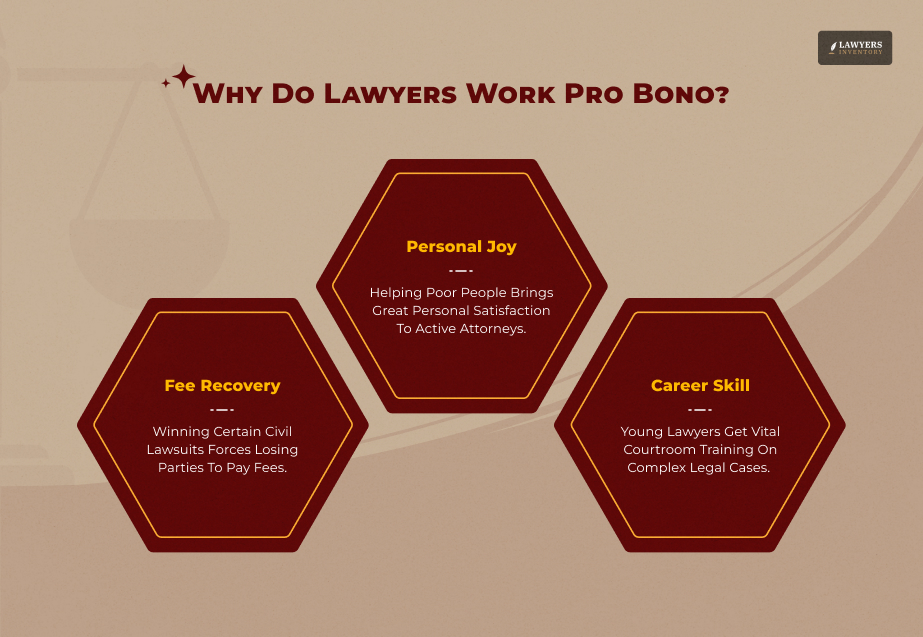
Possibly the best reason to provide pro bono services is the sense of satisfaction that comes from helping others. Pro bono work reminds attorneys that the law is there to serve everyone, regardless of their financial circumstances.
Beyond personal motivation, structural incentives also drive pro bono participation.
Many law firms count pro bono hours toward attorneys’ annual billable hour requirements – treating a pro bono matter the same as a paying client matter for performance evaluation purposes.
This removes a significant disincentive for associates and senior attorneys who face billing pressure.
Pro bono assignments can give young lawyers a chance to lead or argue a case they might not be able to with paying clients. For that reason, pro bono work is often a key benefit young lawyers look for when deciding where to begin their careers. [Source: Thomson Reuters]
In certain cases, attorneys may also recover fees.
When a client prevails in a case involving fee-shifting statutes – certain civil rights, employment discrimination, or consumer protection matters – the court can order the losing party to pay the prevailing party’s attorney fees. A pro bono attorney who wins such a case may receive payment from the defendant.
The client’s representation was still free. The attorney’s time was compensated through the fee-shifting mechanism, not by the client.
Over 75% of U.S. lawyers participate in pro bono work during their careers. The profession’s broad engagement reflects that pro bono is genuinely embedded in legal culture – not an exceptional act by a small minority.
How Pro Bono Lawyers Get Paid – The Complete Picture
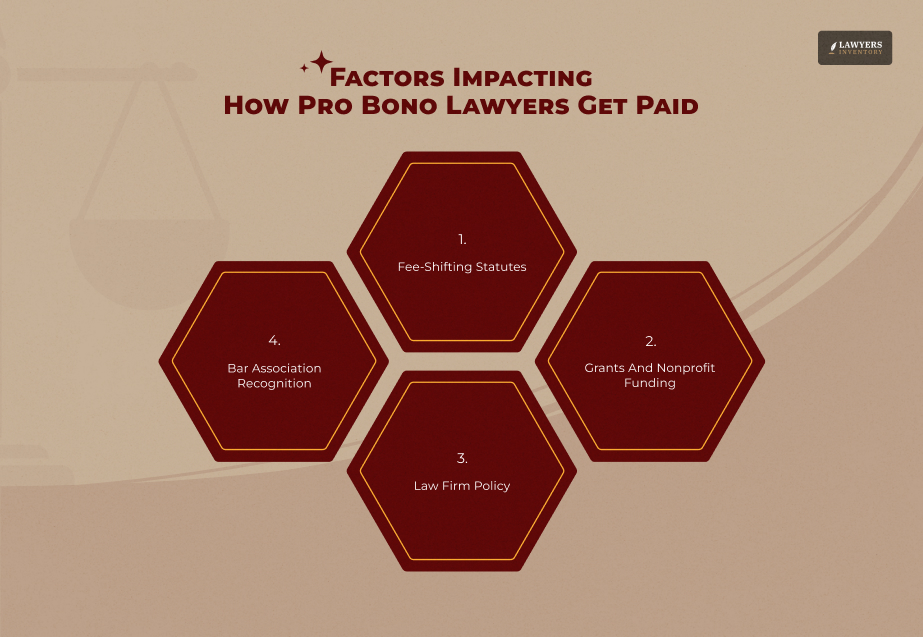
In the vast majority of pro bono matters, attorneys receive no financial compensation. The work is entirely voluntary. The law firm absorbs the cost of the attorney’s time. This is the default and the norm.
However, several exceptions and supplemental structures exist.
Fee-Shifting Statutes
In matters governed by statutes that award attorney fees to prevailing plaintiffs – such as 42 U.S.C. § 1988 in civil rights cases, or the Equal Access to Justice Act in certain federal proceedings – a successful pro bono attorney can petition the court for fees paid by the opposing party. The client pays nothing. The attorney may receive compensation from the defendant.
Grants And Nonprofit Funding
Some pro bono work is conducted through legal aid organizations funded by government grants, foundation support, and IOLTA (Interest on Lawyers’ Trust Accounts) funds.
Attorneys at these organizations are salaried employees – they receive regular compensation for their work, which is fully pro bono to the clients they serve.
Law Firm Policy
Many large and mid-sized firms count pro bono hours as billable toward associate quotas. The attorney receives their regular salary. The cost is absorbed by the firm as a matter of professional responsibility and firm culture.
Bar Association Recognition
Several state bars offer formal recognition, awards, and reporting credit for pro bono hours. While not financial compensation, these professional incentives are meaningful within the legal career context.
The accurate answer to how pro bono lawyers get paid is therefore: usually they are not, directly. But the economic structure of pro bono is more layered than a simple “free” framing suggests.
Pro Bono Internship Meaning: What It Means for Law Students
The pro bono internship is a distinct and important use of the term that most legal dictionaries and general guides ignore entirely.
A pro bono internship is a legal work placement in which a law student or recent graduate provides legal research, drafting, and support services to an organization – typically a nonprofit, legal aid society, public defender’s office, or advocacy organization – without receiving financial compensation.
The intern works for the public good in exchange for practical legal experience, mentorship, and professional development.
Pro bono internships differ from traditional paid internships in both structure and purpose. The student receives no salary.
In return, they gain direct exposure to underserved client populations, complex social justice litigation, and the kind of first-chair responsibility that paying clients rarely extend to junior practitioners.
Many law schools now require pro bono hours as a graduation requirement and maintain dedicated pro bono programs that place students in internship roles with partner organizations.
California, effective 2026, and Indiana are among states that have introduced pro bono reporting requirements – a trend that reflects the growing institutionalization of pro bono as a measurable professional obligation rather than an optional gesture. [Source: Purdue Global Law School]
For law students, a pro bono internship serves a dual function: it fulfills educational requirements while building the kind of substantive experience that distinguishes candidates in a competitive legal job market.
Who Qualifies For Pro Bono Legal Help?
Eligibility for pro bono services varies by program, organization, and jurisdiction. There is no single national standard. However, most pro bono programs screen applicants using two primary factors.
Financial Eligibility
Most programs use income thresholds tied to the federal poverty level. The Legal Services Corporation, the largest funder of civil legal aid in the United States, generally serves individuals and families with incomes at or below 125% of the federal poverty level. Some programs extend to 200% or higher in high cost-of-living areas.
Legal Matter Type
Pro bono programs often prioritize specific legal areas where the justice gap is most acute. These include:
- Housing and eviction defense.
- Domestic violence.
- Immigration.
- Veterans’ benefits.
- Consumer debt.
- Family law.
A program that primarily handles housing matters may decline to assist with a business dispute, even for an income-eligible applicant.
Some matters fall outside traditional pro bono programs entirely regardless of income. Some of the matters that are typically excluded are:
- Purely commercial disputes.
- Cases with strong contingency fee potential.
- Matters involving potential liability for the attorney.
How To Find Pro Bono Legal Help
Finding pro bono representation requires knowing where to look. The following pathways are the most reliable.
State And Local Bar Associations:
Every state bar association maintains a lawyer referral service and can direct inquirers to pro bono programs in their jurisdiction. Many county bar associations operate dedicated pro bono coordinator positions.
Legal Services Corporation Grantees:
The LSC funds legal aid organizations in every state and U.S. territory. Their website maintains a directory of funded programs searchable by location.
These organizations provide direct representation and can refer clients to volunteer attorney programs when their own capacity is full.
Law School Clinics:
Most accredited law schools have clinical programs. These are programs where students under the supervision of a licensed attorney are allowed to give free legal services to qualifying clients.
Law school clinics often address civil matters that legal aid organizations are unable to take on due to limitations on their capacity.
Courthouse Self-Help Centers:
A number of state and federal courthouses have self-help centers that are staffed by attorneys or paralegals. The staff in these centers can offer legal information and referrals.
These centers cannot offer actual representation, of course, but they are good at connecting people with pro bono resources.
Specialized Pro Bono Organizations:
National organizations that operate targeted pro bono programs for specific populations and legal issues include:
- The American Civil Liberties Union.
- Lambda Legal.
- The NAACP Legal Defense Fund.
- Veterans Legal Services.
If your matter falls within their mission area, these organizations are worth contacting directly.
“If you start with one of the public legal service organizations, they will refer clients to an appropriate provider,” says Sharon Stern Gerstman, past president of the New York State Bar Association. That referral chain – from one organization to the next – is how most people ultimately find the representation they need. [Source: Super Lawyers]
What Pro Bono Can And Cannot Do
Pro bono legal services are genuinely valuable. They are also genuinely limited. Understanding both sides of that equation prevents misplaced expectations.
Pro bono representation can provide the same quality of legal work as a paying client would receive. People sometimes expect pro bono lawyers to be less capable or committed to their clients.
That’s not true, experts say.
A pro bono client at a large law firm may receive representation from attorneys with decades of relevant experience, according to U.S. News & World Report.
What pro bono cannot do is meet the full scale of unmet legal need. Pro bono is only one part of a larger, integrated solution to ensuring equal access to justice. There is also a critical need for properly funded legal aid and legal service organizations – and a more user-friendly and accessible court system. [Source: Thomson Reuters]
The 92% of income-eligible Americans who did not receive the legal help they needed did not fail to find it because pro bono does not exist.
They failed to find it because the available supply – from legal aid organizations, pro bono attorneys, and law school clinics combined – cannot match the demand. The justice gap is structural.
Pro bono narrows it. It does not close it.
That context does not diminish the importance of seeking pro bono help when you need it. It does mean that persistence matters. A first contact that ends in a referral is not a dead end. It is the first step in a chain that frequently leads to representation.
Sources:
1. Legal Information Institute, Cornell Law School – Pro Bono (May 2025)
2. American Bar Association – Model Rule 6.1: Voluntary Pro Bono Publico Service
3. FindLaw – Pro Bono Explained (November 2025)
4. FindLaw – Quick Answers to Common Questions About Pro Bono (March 2026)
5. Legal Services Corporation – The Justice Gap Report (2022)
6. American Bar Association – Millions of Americans Continue to Lack Meaningful Access to Justice (April 2026)
7. Thomson Reuters – Bridging the Access to Justice Gap With Legal Pro Bono
8. Thomson Reuters – What Does Pro Bono Work Mean to Attorneys?
9. U.S. News – What Is Pro Bono Law?
10. Super Lawyers – Finding a Pro Bono Lawyer (November 2025)
11. Purdue Global Law School – What Is a Pro Bono Case? (July 2025)
12. PNC Bank – Financial Wellness in the Workplace Report (2025)
13. 42 U.S.C. § 1988 – Civil Rights Attorney’s Fees Awards Act14. Equal Access to Justice Act, 28 U.S.C. § 2412 – Fee Awards in Federal Proceedings
Leave A Reply






Do You Pay Taxes On Lawsuit Settlements? IRC Section 104 Explained
Read More
Non-Disparagement Clause Explained: Requirements, Enforceability, And What Changed Recently
Read More
Best Practices For Successful Trademark Registration
Read More
Understanding Your Rights: A Guide To The Legal Process
Read More
How To Clear A Bench Warrant Without Going To Jail: A Legal Guide
Read More
0 Reply
No comments yet.