
Quick Answer

The automation of routine tasks is changing the functioning of law firms. One of the main ways this happens is through AI for law firms. This frees lawyers from manual administrative work. They no longer need to spend their time on these tasks. Instead, they can spend more time on top-level strategy. They can focus on complicated negotiations and advising clients.
The legal industry is undergoing its most significant technological transformation in a generation.
For decades, the traditional law firm business model relied heavily on manual data collection. It also relied on the billable hour. This framework often resulted in high costs for consumers. It created delayed timelines for everyday people seeking justice.
Today, artificial intelligence is rewriting those rules. AI forces firms to evolve from slow, labor-intensive operations. They are becoming high-efficiency, data-driven practices.
For clients genuinely seeking legal help, this technological shift is not just an internal corporate upgrade for attorneys. It is a major victory for consumer access, affordability, and case quality.
Understanding the modern usage of AI for law firms allows you to interview potential counsel more effectively. It ensures you receive the highest standard of legal representation available.
How AI For Law Firms Helps Professionals With Quality Representation
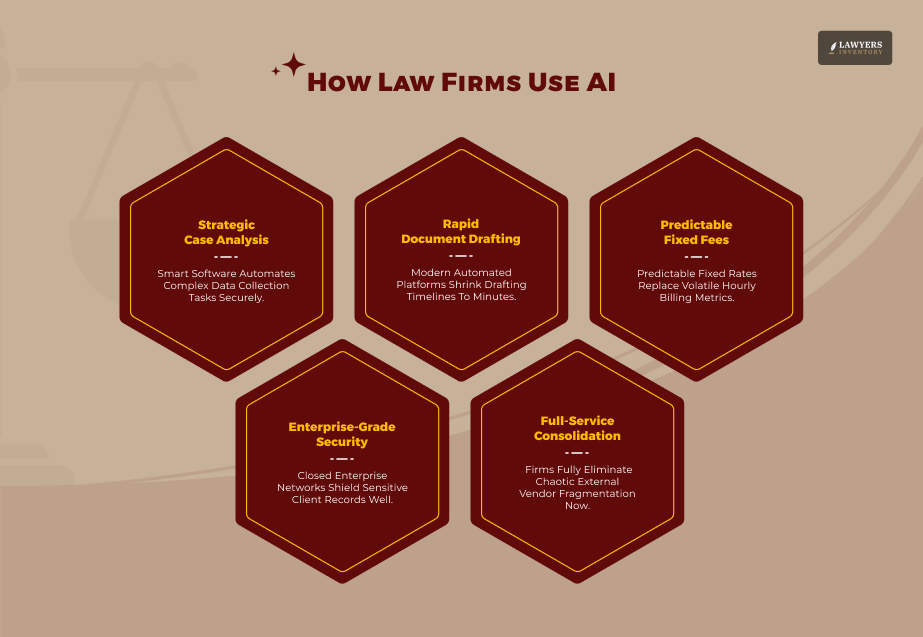
Below are five critical ways modern legal professionals use AI for law firms to accelerate case success. They use it to optimize pricing structures and deliver superior results for their clients.
1. Reversing The 80/20 Rule To Prioritize Strategic Case Analysis
Traditionally, legal representation involved a disproportionate amount of time dedicated to administrative prep work. Attorneys rarely started with courtroom strategy. Instead, they frequently spent up to 80% of their billable hours gathering files.
They sifted through historical records and organized discovery documentation. This left only 20% of their time for high-level strategic analysis, client communication, and creative problem-solving.
Artificial intelligence completely inverts this paradigm.
AI for law firms automates data collection so lawyers can focus on winning your case. Legal teams actively use advanced algorithms to scan thousands of pages of adversarial evidence in seconds.
The software pulls out hidden contradictions and patterns that human eyes might miss during a manual review.
If you are shopping for a tool to help explain these intricate tech shifts to your board, utilizing a ChatGPT video editor online can help create a clean visual summary.
Ultimately, this automation ensures that you pay for an attorney’s sharp legal mind and strategic advocacy. You no longer pay for hours of basic digital paperwork.
Research from the Harvard Law School Center on the Legal Profession confirms this massive operational shift. Their data shows that leading law firms explicitly target the “80/20 inversion” to elevate their overall quality of service.
By automating the foundational information gathering, your legal team can dedicate their best hours to your case. They analyze the specific nuances of your claims, build airtight arguments, and prepare meticulously for depositions or trial cross-examinations.
2. Drastic Reductions In Document Drafting Timelines
The timeline of a standard lawsuit is often long. The sheer volume of paperwork required to initiate and maintain a claim causes these delays.
Drafting complex initial complaints, formal responses, motions, and comprehensive contracts historically required days of manual typing. It required extensive proofreading and cross-referencing of past legal templates.
These delays frustrate clients who are dealing with urgent personal, financial, or corporate crises. These situations require immediate legal intervention.
AI-powered drafting tools reduce these multi-day timelines down to mere minutes. This speed gives firms the agility to respond to legal threats almost instantly.
This technology acts as a highly specialized digital assistant. It instantly generates highly accurate foundational legal documents based on the specific facts of your situation.
| Legal Process Stage | Traditional Manual Method | Modern AI-Assisted System |
| High-Volume Complaint Responses | Up to 16 hours of associate time | 3 to 4 minutes of automated generation |
| Contract and Document Drafting | Multiple days of manual compiling | Minutes via structured templates |
The practical impact of this acceleration is stunning.
Case studies highlighted by Harvard Law School demonstrate that an AI-driven complaint response system successfully reduced associate drafting time in high-volume litigation matters. The software brought the time down from 16 hours to just 3 to 4 minutes.
This does not mean a machine files your lawsuit without human oversight. Instead, a senior attorney reviews, refines, and signs off on a finished product in a fraction of the time. This allows your case to move through the judiciary system much faster.
3. Transitioning From The Billable Hour To Predictable, Fixed-Fee Pricing
The legal billable hour has long been a source of anxiety for individuals and businesses seeking legal counsel.
Under a traditional billable framework, clients face unpredictable monthly invoices. They receive little clarity on the ultimate total cost of their legal matter.
This financial uncertainty often deters people from pursuing valid legal remedies. It forces them to settle prematurely simply to cap their escalating legal expenses.
Fortunately, the exponential productivity gains brought on by artificial intelligence accelerate a shift toward alternative fee arrangements (AFAs).
AI for law firms allows them to standardize their workflows. It predicts exactly how much human effort a case will require.
Because of this predictability, firms confidently offer upfront, predictable pricing models.
| Pricing Element | Traditional Billing Model | AI-Enabled Billing Model |
| Core Structure | Dominance of the billable hour | Fixed-fee and flat-rate packages |
| Cost Predictability | Unpredictable, fluctuating monthly invoices | Upfront, capped budget agreements |
| Value Metric | Tied directly to time spent by staff | Tied to objective deliverables and results |
Leading legal organizations actively evolve their financial frameworks to match these new capabilities.
According to industry insights from Clio, a premier legal technology platform, the integration of automation software directly correlates with a firm’s capacity to offer transparent pricing. They can offer flat-rate pricing for complex tasks.
Rather than charging you for every single minute an attorney spends typing, forward-thinking firms now price their services based on the objective value delivered. This protects consumers from surprise fees.
4. Enterprise-Grade Data Security And Client Confidentiality Controls
A primary concern for any client seeking legal assistance is the absolute protection of data. This includes highly sensitive personal files or proprietary corporate data.
When news of mainstream generative AI models first broke, many legal consumers worried about data handling.
They feared that entering private case facts into a public AI interface would expose their data to external tech firms. They worried it would breach attorney-client privilege.
To address these valid fears, the modern legal sector avoids public, open-source AI applications for law firms. Instead, reputable law firms partner directly with specialized legal tech vendors.
They build isolated, secure, and encrypted digital sandboxes. These closed enterprise systems ensure that your private data never enters the public domain. The tools never utilize your information to train public machine-learning models.
The American Bar Association (ABA) maintains rigorous oversight regarding these security implementations. The ABA continually updates its ethical guidelines to enforce strict technological competency. It mandates data encryption protocols among practicing lawyers.
Furthermore, field interviews conducted by the Harvard Center on the Legal Profession reveal that clients actively collaborate with their outside counsel to dictate exact security parameters.
Modern firms implement mandatory multi-factor authentication. They use advanced data silo structures and continuous vulnerability monitoring. These steps guarantee that your case files remain completely confidential and legally privileged.
5. Expanding Full-Service Capabilities And Eliminating Vendor Fragmentation
Historically, big law firms refused to handle low-margin matters. These matters required repetitive effort. Examples include contract management and routine compliance.
According to the Wolters Kluwer Future Ready Lawyer Survey Report, this work was mostly handed over to specialized little legal firms. It was also given to Alternative Legal Service Providers (ALSPs).
This fragmentation of service providers caused issues. Clients had to manage multiple distinct vendors. They faced communication issues and very high administrative overheads.
Today, artificial intelligence changes the legal landscape. Many legal support services can be handled as a full-service offering under the same roof.
The cost of carrying out these activities drops by a lot. This drop is achieved by automating internal processes.
Because of this, large firms can take on high-volume workloads. They can manage this without massive spikes in client pricing.
Forward-looking firms are looking even further. They are actively diversifying in these technology-driven directions, according to Harvard Law School.
With this shift, your legal team works as one coordinated unit. They analyze routine data efficiently. They use those insights to build courtroom strategies that are a real step ahead.
Identifying A Truly AI-Competent Law Firm
When you look for legal representation, note that not all law firms adopt technology at the same speed.
To ensure you choose a firm that leverages AI to your benefit, ask potential attorneys these targeted questions during your initial consultation:
- What specific AI platforms do you use to streamline document review and legal research for cases like mine?
- How does your technology usage reflect in your billing? Do you offer fixed-fee options or value-based pricing for standard motions or contracts?
- What precise data security measures do you have in place to guarantee my private information is never exposed to public AI training models?
- How will your automated tools accelerate the timeline of my case, and how often can I expect strategic updates from a human attorney?
Choosing a firm that answers these questions confidently ensures you hire a modern, efficient, and highly effective legal advocate.
Leave A Reply






Legal Assistant Vs. Paralegal: The Real Difference And Why It Matters
Read More
Logikcull Review 2026: The eDiscovery Tool 1,500+ Legal Teams Trust – But Should You?
Read More
Legal Case Management Software Explained: How To Choose, What To Avoid, And The Best Tools In 2026
Read More
How To Build A World-Class Law Firm Intake Engine: The Definitive Platform Guide
Read More
0 Reply
No comments yet.