
Family law litigation requires a rare combination of structural discipline and deep financial precision. Unlike transactional legal fields, domestic relations practices must navigate high-stakes personal emotion alongside strict regulatory frameworks.
Attorneys routinely balance complex marital asset distributions, multi-tier child support calculations, and volatile client communications under rigid court deadlines.
Managing this high-stress workflow manually introduces systemic risk and limits a firm’s operational scale.
Modern legal technology addresses these operational pressures through specialized digital solutions: family law software.
However, the legal tech market frequently conflates general office logistics with deep forensic financial modeling or client utilities.
Choosing the wrong family law software can result in non-compliant trust accounting or inaccurate tax projections during critical settlement negotiations.
Best Family Law Software At A Glance
This matrix provides a direct comparison of the 8 leading family law software options based on core operational capabilities and specialized family law requirements:
| Platform | Category | Primary Strength | Key Limitation | Ideal Firm Size |
| MyCase | Practice Management | End-to-end client intake and secure communication portals | Lacks specialized forensic tax asset modeling | Solo to Mid-Sized Practices |
| Clio | Practice Management | Expansive app integration ecosystem and automated forms | Long-term billing data visibility restrictions | Mid-Sized to Enterprise Firms |
| Smokeball | Practice Management | Passive background time tracking and court form libraries | Steep initial learning curve and slow payment processing | Small to Mid-Sized Practices |
| PracticePanther | Practice Management | Quick implementation and clear, visual profitability dashboards | Advanced automated workflows require add-on integrations | Growing Small to Mid-Firms |
| Family Law Software | Financial Calculator | Court-admissible state affidavits and after-tax property splits | No native trust accounting or firm CRM capabilities | All Sizes (As a specialized add-on) |
| Easy Soft | Financial Calculator | Affordable state support sheets and lifestyle budgeting tools | Limited long-term financial modeling and regional focus | Solo Practitioners & Mediators |
| Filevine | Collaborative Project Management | Project-feed collaboration tools and AI document parsing | High implementation costs and lengthy adoption timelines | Large, Multi-Attorney Practices |
| OurFamilyWizard | Client Communication App | Immutable, court-admissible logs of co-parent communications | Lacks firm administrative, billing, or drafting tools | N/A (Client-facing utility) |
The Fundamental Divide In Family Law Technology
Selecting the appropriate family law software platform requires understanding the clear division between a few things:
- General firm operations.
- Specialized forensic calculations.
- External client utilities.
Many firms mistake comprehensive case management for comprehensive financial analysis.
In practice, a platform that excels at tracking billable hours or scheduling depositions cannot model a 30-year after-tax net worth projection for a high-net-worth divorce.
To build an efficient practice, firm leadership must evaluate technology through a multi-tiered framework:
- Legal Practice Management (LPM) Platforms: These systems handle the daily administrative, billing, and compliance workflows of the firm.
- Specialized Financial Calculation Engines: These applications generate court-admissible child support worksheets and complex property division models.
- Specialized Litigation and Client Utilities: These niche tools manage specific evidence channels, project timelines, or direct communication pathways between parties.
High-performing matrimonial firms rarely choose just one category. Instead, they integrate these distinct tools into a unified operational ecosystem.
Top Family Law Software: Legal Practice Management (LPM) Platforms
Legal practice management systems serve as the operational backbone of a family law firm. These cloud-based family law software centralize client intake, automate court-mandated deadlines, secure sensitive communications, and enforce compliant billing practices.
1. MyCase
MyCase functions as an all-in-one practice management solution tailored to streamline client onboarding and day-to-day case logistics for small to mid-sized family law practices.
The platform resolves the administrative bottlenecks that occur during initial domestic relations filings. [Source: Capterra]
The system coordinates client interactions from the initial consultation through final disposition to eliminate data fragmentation.
Core Strengths For Family Law:
The platform includes customizable online intake forms designed specifically to capture sensitive domestic relations data early in the case cycle.
Its integration with LawToolBox automates court calendars by calculating statutory deadlines based on localized jurisdictional rules.
Furthermore, its embedded payment processing engine, LawPay, supports compliant IOLTA trust accounting, allowing firms to manage retainers securely.
Inherent Limitations:
While the platform offers basic document template auto-population, it lacks native, deep financial modeling capabilities for complex marital estates.
It cannot compute complex actuarial valuations for defined-benefit pensions or simulate future tax liabilities for high-net-worth asset division.
2. Clio
Clio is a highly scalable legal practice management platform utilized by larger family law firms requiring extensive third-party software integrations and advanced document drafting.
The platform operates as a broad operational foundation that firms can customize to their specific practice needs. Its modular architecture relies on a connected product suite including Clio Grow and Clio Draft.
Core Strengths for Family Law:
Clio Draft enables rapid, automated generation of complex family law pleadings and local court forms.
The platform connects to hundreds of legal tech applications, allowing firms to build a highly customized software stack. Its robust conflict-checking engine also helps prevent compliance issues during high-volume intake.
Inherent Limitations:
Clio’s native financial tools focus strictly on firm operational accounting and time tracking rather than client estate analysis.
Its native time-tracking tools apply strict historical visibility limits, which can complicate long-term billing analysis for multi-year custody disputes.
3. Smokeball
Smokeball differentiates itself in the practice management space through automated, passive time tracking and deep, localized document automation libraries.
It addresses the chronic under-reporting of billable hours common in document-heavy family law practices. The platform records billable time silently in the background as staff work.
Core Strengths for Family Law:
The platform’s native tracking system records every minute spent drafting parenting plans, custody motions, or correspondence without requiring manual timers.
It maintains an extensive library of localized, pre-loaded family court forms that auto-populate directly from the case file.
Inherent Limitations:
Smokeball requires a significant onboarding and training investment due to its feature density.
Financial reporting fields offer limited customization, and integrated payment processing speeds can lag behind dedicated standalone legal merchant accounts.
4. PracticePanther
PracticePanther emphasizes speed of implementation and highly visual dashboards, making it a popular choice for fast-growing family law firms that need immediate, out-of-the-box utility.
The system specializes in flattening the learning curve for new administrative staff. The software focuses on simplifying the financial invoicing and retainer replenishment relationship between the firm and the client.
Core Strengths for Family Law:
It provides an intuitive portal for rapid, customized client intake forms tailored to domestic relations.
Its native billing tool, PantherPayments, allows firms to seamlessly request trust account deposits, safeguarding IOLTA compliance. The dashboard also offers transparent, real-time tracking of individual case profitability.
Inherent Limitations:
PracticePanther relies heavily on third-party integrations to execute advanced document workflows. Attorneys may experience functional limitations when attempting to build highly nuanced, multi-conditional document templates directly within the platform.
Top Family Law Software: Specialized Financial Calculation Platforms
When domestic litigation shifts from administrative logistics to asset division and support configuration, general practice management tools reach their limits.
Firms require specialized calculation engines to perform complex forensic financial analysis.
5. Family Law Software
Family Law Software is widely recognized as the industry standard for specialized divorce financial analysis and court-mandated financial disclosures.
Used extensively by attorneys, judges, and Certified Divorce Financial Analysts (CDFAs), it operates as a dedicated financial calculation engine rather than an administrative CRM.
The system focuses entirely on financial accuracy and statutory compliance.
Core Strengths for Family Law:
The software automatically generates state-specific financial disclosures, including the California Income & Expense Declaration and the New York Net Worth Statement.
It features a sophisticated after-tax property division model that accounts for the long-term tax implications of asset splits.
It also provides actuarially precise defined-benefit pension valuations and detailed child support arrears tracking with variable interest rates.
Inherent Limitations:
The platform does not function as a comprehensive firm management tool. It lacks built-in IOLTA trust accounting, firm-wide calendars, front-end intake CRMs, and generalized staff task-chaining features.
6. Easy Soft (Divorce Financials)
Easy Soft provides a streamlined, cost-effective alternative for family law professionals focused primarily on local child support calculations and basic marital settlement agreements.
It serves as a practical financial application for mediation environments and smaller practices. The software prioritizes speed and direct compliance within its supported jurisdictions.
Core Strengths for Family Law:
It excels at generating state-specific Case Information Statements (CIS) and precise child support worksheets.
The software includes historical expenditure comparators that help attorneys build realistic post-divorce marital lifestyle budgets.
Inherent Limitations:
The platform’s geographic availability is highly specialized, making it less suitable for firms handling multi-jurisdictional matters.
It also lacks the multi-decade after-tax net worth cash flow projections found in more comprehensive financial modeling tools.
Top Specialized Litigation And Client Utilities
Beyond legal billing and calculations, family law firms frequently leverage specialized platforms designed to handle unique evidentiary workflows or court-mandated family interactions.
7. Filevine
Filevine approaches case management from a highly collaborative, project-centric perspective, turning standard legal matters into real-time operational communication feeds. It is built for collaborative matrimonial teams handling heavy litigation workloads.
The platform treats every divorce or custody matter as an evolving project timeline to keep task dependencies completely transparent.
Core Strengths for Family Law:
Filevine features custom task-chaining and automated deadline triggers that prevent critical mediation or discovery windows from slipping through the cracks.
It also incorporates AI-driven document tools that assist in parsing, reviewing, and organizing high-volume financial discovery data.
Inherent Limitations:
The total cost of ownership and implementation complexity are significantly higher than standard out-of-the-box CRMs.
Because the architecture is built to serve a wide array of litigation types, it lacks hyper-specific, built-in family law financial engines.
8. OurFamilyWizard
OurFamilyWizard occupies a distinct niche by functioning primarily as a secure, court-approved communication and recordkeeping utility for separated or divorced co-parents.
While attorneys do not use it to run firm operations, it is a critical tool within a family lawyer’s litigation kit.
The application serves to capture unvarnished, admissible communications between adverse parties.
Core Strengths for Family Law:
The platform documents all parental communications, expenses, and schedule changes in an immutable, court-admissible log. It includes a specialized “ToneMeter” tool to help de-escalate high-conflict dialogue.
Attorneys can directly access downloaded records to present clear, unedited communication timelines to family court judges.
Inherent Limitations:
It is entirely client-facing and offers no practice management features for a law firm. It cannot track firm billable time, manage firm accounting, draft legal pleadings, or run localized child support calculations.
Key Technical Specifications For Matrimonial Practices
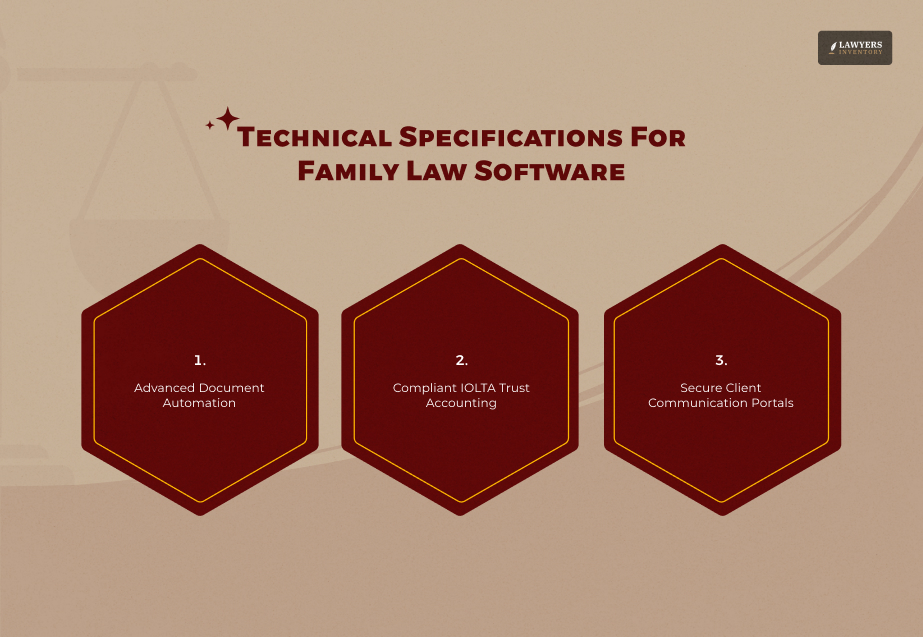
When upgrading a firm’s technology infrastructure, managing partners must look beyond standard sales features.
Family law cases involve strict regulatory requirements and high emotional volatility, making specific technical capabilities critical for risk management.
Advanced Document Automation
Matrimonial litigation is notoriously document-heavy, requiring parenting plans, motions, temporary orders, and extensive financial declarations.
Manual data entry across multiple forms introduces inconsistencies that can damage a firm’s credibility in court. Modern platforms solve this by using single-source data entry architectures.
When a client’s biographical data, asset values, or dependent details are updated in the primary file, those changes instantly propagate across all active templates, ensuring absolute consistency across every pleading and disclosure.
Compliant IOLTA Trust Accounting
Managing retainer fees safely is a critical compliance requirement in domestic relations law. Given the high frequency of billing disputes and the regular replenishment of retainers during prolonged custody battles, general business accounting tools like QuickBooks are often insufficient on their own.
Practices require specialized legal accounting tools that natively segregate operating capital from client trust funds.
The ideal system prevents overdrafts at the individual matter level, prints physical checks directly from trust accounts, and maintains a clean, continuous audit trail that fully complies with state bar association IOLTA requirements. [Source: Federal Bar Association]
Secure Client Communication Portals
Relying on standard personal email or SMS for client communications during intense custody or divorce disputes introduces significant security and operational risks.
Standard email is vulnerable to accidental third-party exposure and leaves data unorganized across disparate platforms.
Dedicated client portals solve this by providing encrypted environments for exchanging messages, uploading sensitive financial documents, and tracking case updates.
By moving communications inside a secure, centralized system, firms safeguard attorney-client privilege, keep messages organized directly within the relevant digital case file, and establish clear operational boundaries for clients.
Rules-Based Court Calendaring
Missing a statutory filing window or an evaluation deadline in a family law matter can lead to severe malpractice liability and compromise a client’s position.
Manual calendar management leaves firms vulnerable to administrative oversight. Automated, rules-based calendaring systems address this by integrating jurisdictional court rules directly into the firm’s master schedule.
When a trial or hearing date is entered, the family law software automatically calculates and populates all associated statutory deadlines – such as discovery cutoff dates, motion response windows, and exhibit disclosure timelines – and dynamically updates them if the court changes the primary appearance date.
Leave A Reply







How Long Does A Background Check Take? What The Law Allows And What To Expect
Read More
Background Check Basics: What It Shows, What’s Off-Limits, And Your Rights
Read More
How AI-Driven Law Firms Deliver Higher-Quality Representation For Less
Read More
Legal Assistant Vs. Paralegal: The Real Difference And Why It Matters
Read More
Logikcull Review 2026: The eDiscovery Tool 1,500+ Legal Teams Trust – But Should You?
Read More
0 Reply
No comments yet.