Summarize using AI





Prompt copied. Paste it into Gemini.
Listen to this article
Quick Answer:
The LSAT Argumentative Writing section is a mandatory, zero-point, 50 minute online Essay that you must complete in order to view your test scores. It can be completed on-demand up to 8 days before your LSAT date. You will have 15 minutes to plan and write using the digital notepad. This section cannot be completed on paper.
The LSAT argumentative section is an untimed section that is mandatory to complete. This section tests your clear writing skills and fast thinking.
Whilst the multiple choice sections test your logical and reading skills, the argument section of the test shows your ability to form a strong argument from conflicting pieces of facts.
This raw piece of writing gives the law school admissions offices insight into your natural writing style without any editing.
If you’re looking to learn how to study for your LSAT, knowing how to complete this timed essay will become an important factor to help you stand out from the crowd.
Knowing how difficult the LSAT can be will require you to understand how to manage your time to plan and write a full essay in one short session.
The legal industry requires professionals who can read large amounts of information and create coherent arguments quickly.
The Structural Shift To LSAT Argumentative Writing
The modern test is very different to the previous format where you had to simply choose between option A or B.
You will be provided with a topic and three or four different perspectives to consider. These will relate to different values, beliefs or cultural aspects. [Source: Law School Admission Council (LSAC)]
Take a look at an LSAT example of an argumentative essay question to see what a complex question looks like.
Your task is to then decide on a clear stance and write an essay considering the arguments within the different perspectives.
Everything within this section must be completed online within 50 minutes. You will be monitored by a remote proctor who will check your screen, webcam and microphone.
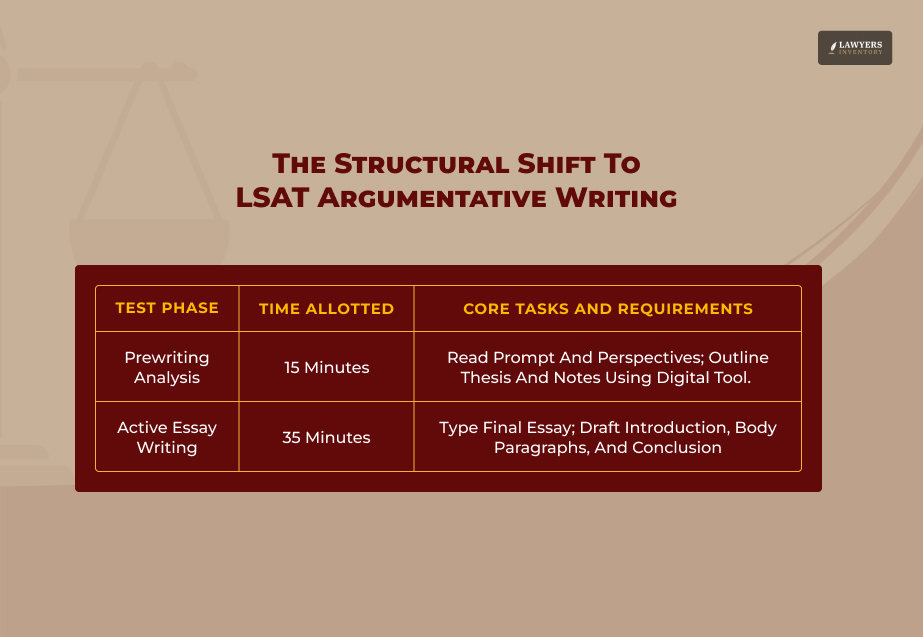
“Most test takers will have a total of 50 minutes – 15 minutes for prewriting analysis and 35 minutes for essay writing,” reports the Law School Admission Council (LSAC) Website.
There are two separate sections:
| Test Phase | Time Allotted | Core Tasks and Requirements |
| Prewriting Analysis | 15 Minutes | Read prompt and perspectives; outline thesis and notes using digital tool. |
| Active Essay Writing | 35 Minutes | Type final essay; draft introduction, body paragraphs, and conclusion |
The new format ensures law schools can see how well you can create an original opinion.
While many law schools do not require you to take the LSAT and may use alternatives such as the GRE or path programs, the majority will still look closely at this piece of validated writing.
The faculty admissions committee will look at the ungraded essay to ensure the applicants personal statement is reflecting their true writing ability.
According to Manhattan Review, if the student’s main application looks perfect but their timed essay is poorly written with bad grammar and structure they may have their file flagged for using unauthorized AI tools.
The 15-Minute Prewriting Strategy: Architectural Blueprint
The first 15 minutes of the test are meant for three specific things:
- Reading.
- Analyzing.
- Planning.
Many people will make the mistake of reading through the text slowly and waiting for the timer to begin.
Use this precious time to plan your essay and create a clear outline of your points both in your mind and written down.
This helps you create a flowing essay rather than an essay full of bullet points. If you want to know what LSAT score do you need for Harvard or other top schools, your performance must be up to the same standard as your multiple choice section.
If you do not plan your essay well within the first 15 minutes then your essay will become a mess when you are trying to type in a short amount of time.
As law school is expensive many applicants will want to know how much is law school and try to gain any edge they can to get merit aid.
A poor essay can ruin an otherwise brilliant application so it is important that you know how to quickly organize your facts using the simple tools on your screen to ensure your score isn’t affected.
Designing the Digital Notepad Matrix
During this section you will NOT be able to use any paper, pen or pencil.
The digital notepad provided will ask you to type in your notes in basic font. This will also not allow any bold fonts or paragraphs. You will have a limited space to type in.
Type short notes instead of full sentences. This can be done by using a simple code to show how the different perspectives link together.
To make it easy to follow, type:
- Core Theme: Each perspective should have a 1-word title showing what the core theme is (e.g. Money, Ethics, Social, Community).
- Hidden Flaw: Write a one-sentence summary underneath the title showing the most obvious flaw.
- Main Thesis: At the top of your notes type your exact conclusion.
- Supporting ideas: Note down which perspectives support your argument and which ones you need to argue against.
By creating a simple written guide, you will save yourself the hassle of having to scroll up and down your screen to re-read the prompt. This will save you precious minutes of thinking time.
The 35-Minute Drafting Phase: Execution Under Pressure
You must start writing your final essay when the timer automatically changes to the 35-minute slot.
Time management while writing is really important here, as the system will save and submit whatever you have written as soon as the time runs out. Every paragraph you write must have a definite purpose.
The aim here is to show the readers that you can bring together various opinions into one flowing and persuasive piece of writing.
In order to win a very competitive law school scholarship, it is important to show off your high level analytical skills.
By writing the essay in a clear and structured manner, you are telling the school that you are prepared for the busy reading and writing schedules required when studying law.
Many students looking to follow this career path often wonder how long does it take to get a law degree.
This three year journey begins by demonstrating that you can write clearly when under extreme time pressure. Keep your writing simple, active and to the point throughout your whole essay.
Paragraph-by-Paragraph Structure Breakdown
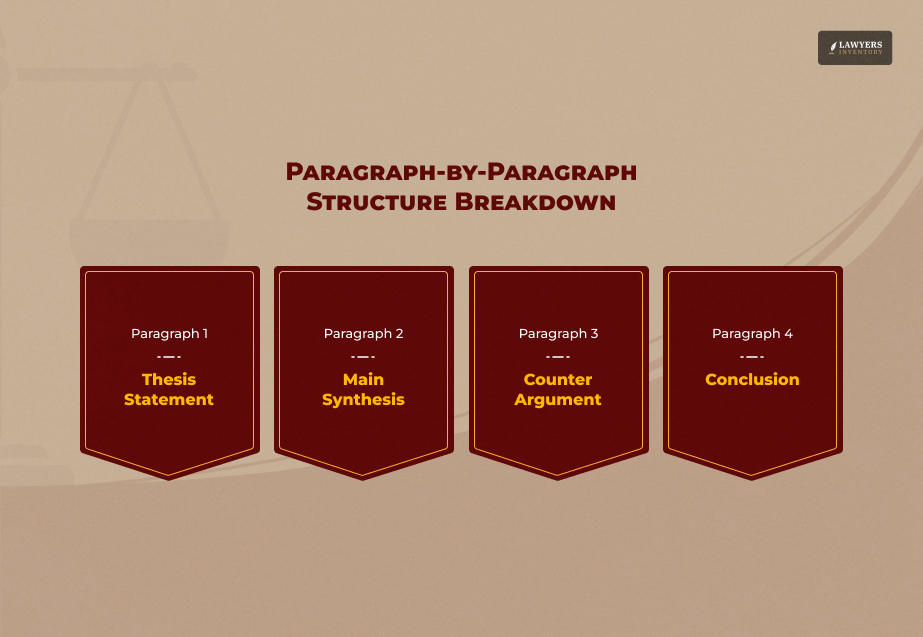
Ensure your essay has an effective structure of either four or five paragraphs to create an easy-to-read piece of work.
Paragraph 1: Thesis Statement
Ensure your first sentence clearly states your stance on the issue.
Avoid any vague statements, lengthy introductions or flowery language. Ensure your stance is clearly stated. Mention how the different perspectives will help prove your point.
A clear thesis statement will display you as a professional and give the reader clarity on what to expect.
Paragraph 2: Main Synthesis
In this paragraph ensure you group all the viewpoints that support your thesis together. Try not to write about each individually but instead link them.
For example, if one talks about financial security and another community development, explain how the first gives a practical foundation to the second.
Paragraph 3: Counter Argument
An effective legal argument will acknowledge the opposing argument. In this paragraph consider the viewpoints that oppose your stance.
Highlight any flaws in logic, assumptions or real-world weaknesses. Making the opposing argument easy to break down will make your argument appear far more reasonable.
Paragraph 4: Conclusion
In your final paragraph you should not simply repeat your introduction. Instead, link your argument to wider issues in the real world.
This will show how this topic impacts on current social, economic or legal decisions. This will prove to your readers that you can consider wider policy issues.
Relevance To Modern Law Admissions
Admissions directors will read this piece to get an idea of how you are able to problem solve without the support of books, internet resources or tutors. It shows real baseline communication skills.
In terms of what you can do with a law degree the answers will always be about being able to write clear briefs, advise clients and manage risk. Admissions will look at this to see if you have these skills.
This will also help to highlight your potential in non traditional legal roles. The job market has changed dramatically and there are many fulfilling alternative legal careers – including but not limited to risk management within corporate environments, compliance, legal tech and public policy design.
To succeed in these areas you need this specific skill. The ability to analyze different perspectives and write clear, concise policy documents.
Long-Term Dividends: From Law School To The Bar
The skills you practice for this entry essay are the exact same skills you will need to pass your professional licensing tests later.
The traditional UBE Bar exam (Uniform Bar Examination) has long included a performance element, requiring candidates to organize client files, statutes and facts within tight time constraints. Therefore developing good essay habits will help you reach these key milestones in your career.
With licensing exams changing to the new NextGen Bar exam, this will provide you with an invaluable skill. The new exam focuses on practical elements of being a lawyer.
Questions are incorporated throughout the exam ensuring you can quickly research, predictively write and advocate.
If your ultimate career goal is to work within the public sector as a judge (often asked, do you need a law degree to be a judge?), then developing your synthesis skills is key.
Your ability to create quick, accurate and structured summaries will determine your success from your initial application to law school through to your final licensing exam.
Mastering The Clock
Structuring a great essay under strict time constraints requires a calm, disciplined approach to the LawHub platform.
You can use the 15 minutes of your planning phase to plan your arguments and then use the 35 minutes of your writing phase to structure and write a coherent answer. This will help put this stressful part of the application in your favor.
Make sure that you are not just adding this section as an afterthought. Be clear in how you are using your digital notepad. Write in an active and simple manner to produce a well-structured essay that will stand out to the admissions committee.
Disclaimer:
The information provided in this article is for general informational purposes only. It does not, and is not intended to, constitute legal advice. Please consult an attorney for legal help.
Sources:
- Law School Admission Council (LSAC): LSAT Argumentative Writing
- LawHub: LSAT Argumentative Writing
- 7Sage: LSAT Argumentative Writing and How to Prepare
- Manhattan Review: LSAT Writing Section Strategy
- The Princeton Review: LSAT Argumentative Writing: Does It Matter to Law Schools?
Leave A Reply






Which Programs Allow Alternative Admissions Metrics? [The Test-Optional Law School Trend]
Read More
Skills vs. Memorization: Why The LSAT Fails Rote Learners And How The Curve Works
Read More
How To Study For The LSAT? The Exact Study Protocol Used By Top LSAT Test-Takers
Read More
The Complete Law School Timeline: Traditional, Accelerated, And Part-Time Pathways Compared
Read More
What Is The True Cost Of A JD: Tuition Sticker Price Vs. Hidden Living And Interest Traps
Read More
0 Reply
No comments yet.