Summarize using AI





Prompt copied. Paste it into Gemini.
Quick Answer: Mediation vs Arbitration

Mediation and arbitration offer you alternatives if you can't agree and decide what’s best outside of a court. The one big distinction between mediation vs arbitration is a matter of who makes the final decision. In mediation, third-party facilitators help with the discussion in such a way as to bring both parties to a compromise. In arbitration, the matter of fact will rest in the hands of a private arbitrator who, based on the presented evidence and the applicable rules, will come up with a judgment that binds you.
When a dispute arises, you do not have to go to trial. Modern contracts heavily rely on Alternative Dispute Resolution (ADR).
The two primary mechanisms of ADR are mediation and arbitration. Both resolve disputes outside a traditional public courtroom. However, they operate on completely different procedural rules and legal philosophies.
The core difference comes down to one question: who controls the final outcome?
In mediation, the disputing parties decide whether to settle. In arbitration, a neutral third party makes a binding decision. This single distinction shapes your discovery rights, overall costs, and appeal options.
What Is Mediation?
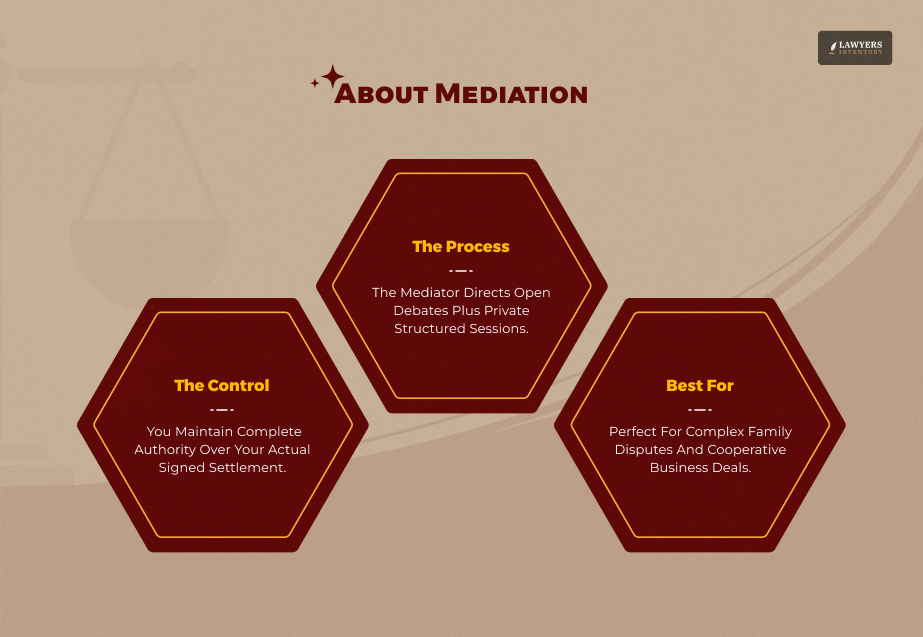
Mediation is a structured negotiation. The parties resolve their disputes with assistance. A neutral third party acts as the mediator.
The mediator’s role is highly limited. They cannot decide, award, or adjudicate. A mediator cannot force one party to pay another. Additionally, they cannot declare one party a winner.
Instead, as the American Arbitration Association mentions, the mediator acts as a facilitator. They help:
- Parties communicate.
- Identify differences in viewpoints.
- Parties find solutions together.
The U.S. Courts ADR Guide defines mediation as a facilitative process by a neutral third party.
The WIPO Mediation Guide highlights another key feature. The process is completely consensual. A party might agree to mediate through a contract. However, the result remains non-binding. [Source: World Intellectual Property Organization]
No party must agree to an unsatisfactory settlement. Because the mediator does not issue a ruling, the procedure remains flexible. A typical mediation follows these steps:
- Selection: The parties mutually choose a mediator.
- Information Sharing: Each side submits a confidential position paper.
- Joint Sessions: Both sides state their positions in the same room.
- Private Caucuses: The mediator separates the parties. The mediator moves between private rooms to test arguments and float settlement terms.
- Settlement: Legal counsel drafts a binding contract if the parties reach an agreement.
What Is Arbitration?
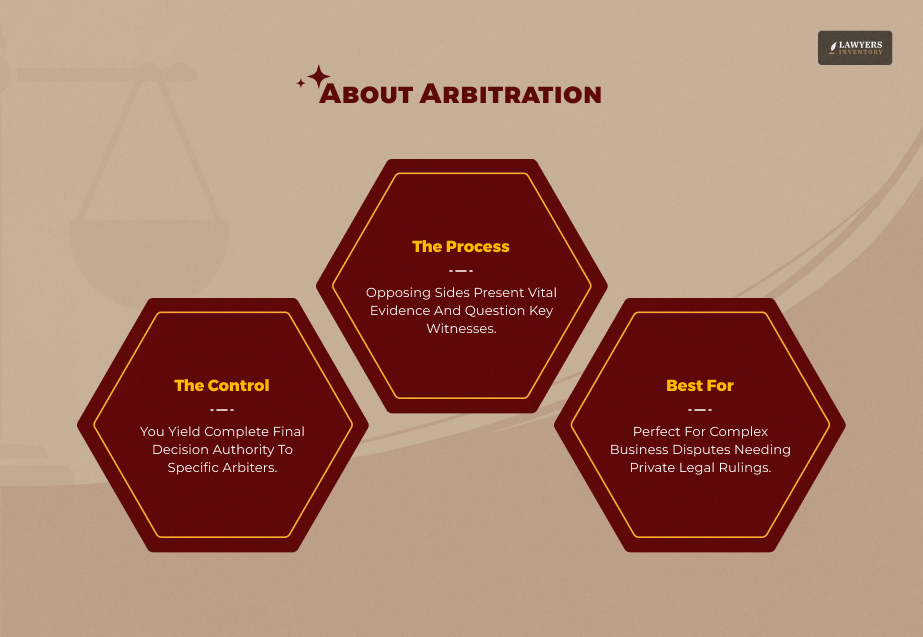
Arbitration is a non-public adjudicative process of resolving disputes privately. Although it closely resembles a formal court trial, it is done in a private judicial system away from the public. An arbitrator or a three-member committee renders a decision on the matter.
Arbitration is seen by the WIPO Arbitration Framework as one of the most formal, rights-based procedures. Signing a binding arbitration agreement means you give up your right to a jury trial.
You transfer complete decision-making authority to the arbitrator. The arbitrator issues a final ruling called an arbitral award.
The procedural roadmap of an arbitration is adversarial:
- Appointment: Parties choose arbitrators based on technical industry expertise.
- Pleadings: The claimant files a statement of claim, and the respondent replies with a defense.
- Discovery: Parties exchange relevant documents and evidence.
- Hearings: Both sides present physical evidence and introduce witness testimony.
- The Award: The tribunal deliberates and issues a binding written award.
The Critical Distinction: Interests vs. Rights
To choose strategically, look at how the WIPO Center differentiates their legal philosophies. WIPO describes mediation as an interest-based process and arbitration as a rights-based process.
An arbitrator looks backward at past conduct. They review the text of the contract and apply the governing law. The remedies are binary: one party breached, and the other party wins damages.
In mediation, the parties look forward at ongoing business interests. A mediator helps parties craft highly creative remedies. Courts and arbitrators lack the legal authority to grant these creative solutions.
For example, suppose two technology firms dispute a patent license. An arbitrator can only rule on whether a breach occurred.
A mediation allows the companies to negotiate an entirely new joint-venture agreement. They can adjust future royalty rates and preserve a profitable business relationship.
Mediation vs Arbitration: Evaluating The Pragmatic Trade-offs
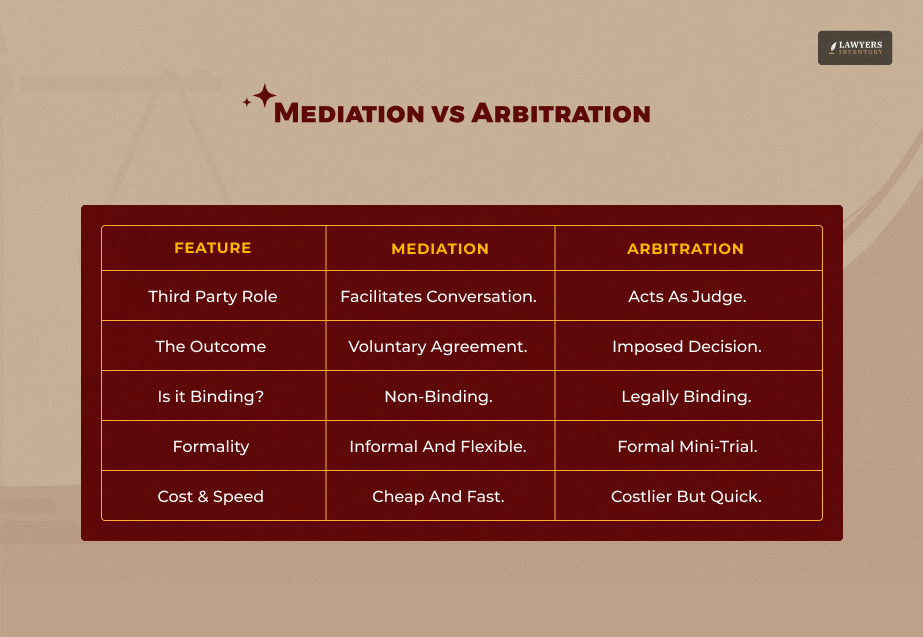
Here are some of the differences between mediation vs arbitration that you must know:
1. Cost And Timeline Realities
You must understand that mediation is not necessarily quicker. You should also know that arbitration is not always economical.
Mediation can settle your dispute in a single day. This process enables you to sidestep months of trial preparation. However, your mediation might not go well. In that case, the money spent on the mediator’s service is gone. The two sides must then file a lawsuit or start an arbitration from scratch.
Arbitration avoids the congestion and gridlock of the court system when it comes to the scheduling of court cases.
Besides, a trial in a public place might be the farthest from being the fastest means for the resolution of disputes. Yet, an in-depth analysis of an international commercial arbitration can easily stretch well beyond one year.
Additionally, parties must bear significant expenses. You must pay private arbitrator fees. You must also pay administrative fees to the management bodies.
Furthermore, complex disputes frequently require high expenses for multiple expert witnesses, meaning overall costs can rival or exceed traditional litigation.
2. Confidentiality Rules
Privacy and confidentiality mean different things in this context. Privacy means the public cannot access the hearing. Confidentiality restricts the parties from sharing documents or statements with outsiders.
The actual level of confidentiality depends on specific rules. It relies on the law and regulations chosen by the parties. For example, the WIPO Mediation Rules contain strong safeguards. They strictly prohibit using statements made during mediation as evidence in future court cases.
The WIPO Arbitration Rules also protect privacy. However, a major drawback exists. The final award could become public if a party petitions a court to enforce or vacate it.
You should never assume total confidentiality. It is always safest to read the exact procedural rules first.
3. Finality And Appeal Rights
A mediation settlement agreement is a contract. If a party violates it, you must sue for breach of contract. There is no concept of an “appeal” in mediation.
An arbitral award is final and legally binding. The avenues to challenge an arbitration award in court are extraordinarily narrow. A court will never overturn an award simply because the arbitrator misunderstood the facts or the law.
In the USA, a court may annul an arbitral award under specific conditions. 9 U.S.C. § 10 of the Federal Arbitration Act (FAA) outlines these narrow grounds. [Source: Legal Information Institute]
A court looks for corruption, fraud, or evident partiality. It also checks for procedural misconduct by the arbitrators.
The U.S. Supreme Court reinforced this strict standard in Hall Street Associates, L.L.C. v. Mattel, Inc. (2008). The Court held that these statutory grounds are entirely exclusive. [Source: Justia]
Consequently, there is no judicial review beyond the text of the law. This restriction makes an arbitration award almost entirely unappealable.
Regional Legal Frameworks: US vs. India
National laws dictate how these processes are initiated and enforced.
The United States Framework
Under US law, arbitration agreements in commercial cases are subject to the Federal Arbitration Act (FAA). [Source: Legal Information Institute]
US courts must enforce these agreements strictly if a valid contract includes a mandatory pre-dispute arbitration clause. As a direct result, courts will immediately stay or dismiss public lawsuits.
Yet, federal lawmakers have drawn clear lines against forced arbitration in certain areas. Congress amended the FAA through the Ending Forced Arbitration of Sexual Assault and Sexual Harassment Act of 2021.
This legislation gives complainants the sole power to cancel pre-dispute arbitration clauses involving sexual misconduct. They can choose to have themselves represented in civil courts instead.
The India Framework
India provides a comprehensive statutory framework that integrates both mechanisms.
The Mediation Act, 2023
The Ministry of Law and Justice released the Act in an official Gazette on October 9, 2023. This step started a gradual, phased rollout of the legislation. [Source: Indian Kanoon]
The Act gives clear, structured definitions to crucial terms. Section 39 specifically covers terms like pre-litigation mediation, standard mediation, and online dispute resolution.
A powerful enforcement mechanism sits within Section 27 (and supplemented by Section 28). These sections require a Mediated Settlement Agreement to have equal legal value to a final judgment or decree from a civil court. Because of these clear rules, mediation in India is highly organized and legally compelling. [Source: IBC Law]
The Arbitration And Conciliation Act, 1996
The Arbitration and Conciliation Act, 1996 serves as the primary legislation governing arbitration in India. To view the most up-to-date revisions of this text, you can consult India’s official national law database. [Source: India Code]
The global community increasingly views India as a top jurisdiction for alternative dispute resolution. The local legal environment strongly backs this trend. Indian courts actively practice judicial non-intervention, meaning they seldom interfere in valid arbitral proceedings.
Synergy Via Section 30
A powerful synergy exists between these different modes of dispute resolution. Section 30 of the Arbitration and Conciliation Act, 1996 provides a unique bridge.
It allows an arbitral tribunal to encourage the parties to settle their dispute through mediation or conciliation at any stage of the proceedings.
If the parties successfully reach an agreement, the tribunal records that settlement. It is then issued formally as an arbitral award on agreed terms. This consent award holds the exact same legal status, authority, and enforcement power as any regular final arbitration award.
Effectively, an arbitral award born from a mutual agreement carries the full weight of a court judgment.
Mediation vs Arbitration: Which Fits Your Situation?
Analyze the following parameters before choosing a path:
- Check for Multi-Step Clauses: Review the underlying contract immediately. If it specifies a mandatory sequence (Negotiation – Mediation – Arbitration), you must follow it strictly. Skipping steps can cause a judge or tribunal to dismiss your claim.
- Assess Relationship Values: If the dispute involves an essential joint-venture partner, focus on mediation. It prevents the scorched-earth dynamic inherent to arbitration.
- Evaluate Emergency Risks: If you need an immediate asset freeze, choose arbitration or litigation. Institutional rules provide emergency arbitrator mechanisms to issue binding interim injunctions. Mediation cannot order emergency freezes.
- Determine Asset Locations: If the opposing party is a foreign entity, arbitration provides an unmatched global enforcement net via the New York Convention.
The Cross-Border Enforcement Matrix
For international corporate disputes, the mechanism of enforcement is often the decisive factor.
If an international transaction breaks down, enforcing a domestic court judgment abroad is difficult. No universal global treaty governs the cross-border recognition of court judgments.
Arbitration provides a globally recognized way to handle disputes under the United Nations New York Convention. More than 170 countries around the world have already ratified or acceded to this treaty.
The convention imposes a binding legal obligation on all member states. They must acknowledge and carry out foreign arbitral awards.
For example, if an award is decided in London, the winning party can easily seize assets located in Mumbai or New York. [Source: LexisNexis]For cross-border mediation, the United Nations Singapore Convention on Mediation provides a similar framework. It allows businesses to enforce a cross-border mediated settlement agreement directly through the courts of a member state, bypassing regular breach-of-contract litigation.
Leave A Reply






Do You Pay Taxes On Lawsuit Settlements? IRC Section 104 Explained
Read More
Non-Disparagement Clause Explained: Requirements, Enforceability, And What Changed Recently
Read More
Best Practices For Successful Trademark Registration
Read More
Understanding Your Rights: A Guide To The Legal Process
Read More
How To Clear A Bench Warrant Without Going To Jail: A Legal Guide
Read More
2 Reply
What Is Litigation? Legal Process, Costs, & When You Need It
September 8, 2026 at 7:57 am
[…] actually involves: how the process works, what it tends to cost, how it stacks up against arbitration and mediation, and how to figure out whether court is even the right […]
ReplyLitigation Vs Arbitration: Which One Decides Your Case?
August 31, 2026 at 8:36 am
[…] is a more consistent advantage for arbitration. Court filings are typically public unless sealed. Arbitration proceedings, and often their […]
Reply