Summarize using AI





Prompt copied. Paste it into Gemini.
Quick Answer: What Are Attorneys General Robocall Warning Letters?

The Attorneys General Robocall Warning Letters are an official cease-and-desist notice that a group of state attorneys general sends to voice service providers. These letters officially tell the phone companies that their networks are used for illegal, scam calls and call on them to take immediate action to prevent the threat of serious civil lawsuits and being removed from the federal list.
The latest operation conducted by the Anti-Robocall Litigation Task Force was the “Operation Robocall Roundup.” It saw a massive collective of state Attorneys General Robocall Warning Letters/notices to dozens of telecommunication companies. [Source: Attorney General Jeff Jackson]
Such a collective effort was a huge step in fighting illicit scam calls. Instead of solely focusing on scammers, state attorneys general are going after companies that aid scammers. Such a move puts scammers in the ‘cone of shame.’
The Scale Of The Problem: Why The Crackdown Occurred
“Americans receive tens of millions of unsolicited automated calls and texts each day, often intended to dupe them into forking over personal information or money,” reports CBS News.
The Attorneys General Robocall Warning Letters show that Illegal robotic calls are not a nuisance but a threat to consumers.
They are also an instance of consumer fraud. These appear in different formats, such as a call from a government agency, a bank, or a tech company.
The Financial Cost Of Robocalls
Americans are receiving approximately a billion calls per year. As stated, a recorded estimated 2.56 billion calls were placed each month from January to September in 2025 alone.
An overwhelming number of these kinds of calls leaves the affected with a very heavy financial burden.
The warning letters became necessary after consumers lost money due to phone scamming. The median losses have only been increasing to show how these scammers have succeeded in their work.
Estimated losses to these kinds of global scam calls in 2025 have already surpassed $80 billion.
Attorneys General Robocall Warning Letters And The Anti-Robocall Litigation Task Force
The Anti-Robocall Litigation Task Force was formed in 2022. It comprises a total of 51 attorneys general from states and territories.
A bipartisan effort, it collaborates with each other to investigate and sue companies that are engaged in a considerable number of illegal and fraudulent calls.
As per official press releases, the last enforcement notices written to consumers definitely have repercussions of this. [Source: Office of the Attorney General, DoJ]
Who Was Targeted In Attorneys General Robocall Warning Letters And Why
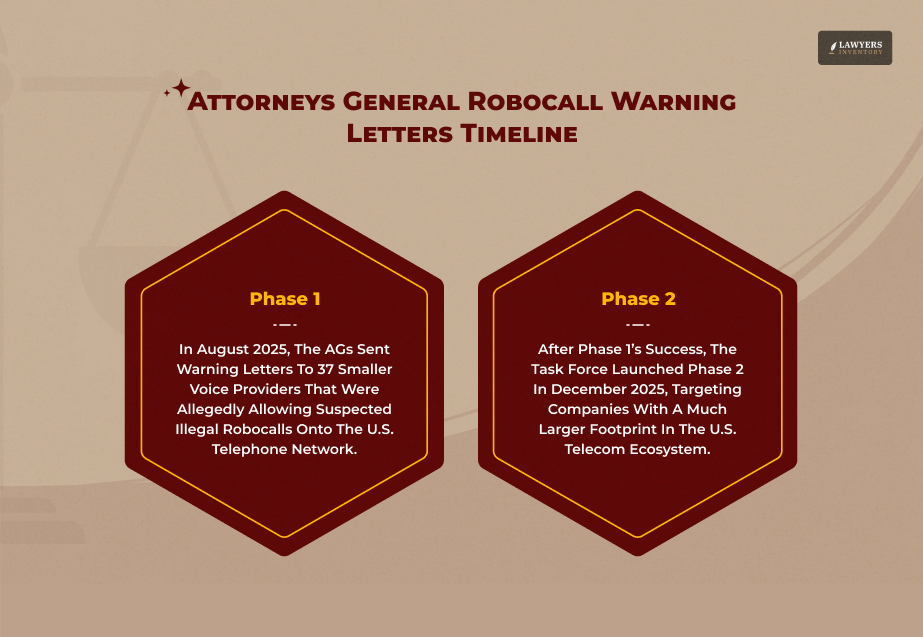
According to Fox 61, the “Operation Robocall Roundup” in 2025 targeted two phases related to providers.
1. Phase One:
The Anti-Robocall Litigation Task Force launched this first phase targeting smaller providers.
They sent the warning letters to 37 voice service providers concerning robocalls. These providers carried out the scam calls on a staggering scale.
Moreover, they notified another 99 downstream providers that they were conducting business with these problematic firms.
2. Phase Two:
Later in 2025, the AGs expanded their reach. They sent warning letters to other major voice service providers, including the following.
- Lumen Technologies, Inc.,
- Peerless Network, Inc.,
- Bandwidth, Inc., and
- Inteliquent, Inc. (PA AG).
The Task Force alleged these major companies were cumulatively involved in scam calls amounting to billions, including Social Security, IRS, Amazon, and Apple scam calls. The volume of calls makes them ideal targets for AG Warning Letters.
Alleged Violations Of Federal Rules
The Attorneys General Robocall Warning Letters mandate that these service providers immediately cease rerouting allegedly illicit calls.
The major complaints concern the failure to comply with FCC rules about robocalls. In this case, these allegedly violating companies did not:
Respond To Traceback Requests
Traceback is done in conjunction with industry partners in order to trace an illegal call to its origin. Failure to respond to traceback requests will make it impossible to trace an illegal call to its origin.
Join In The FCC’s Robocall Mitigation Database
Every voice service provider must register and state their good faith efforts to halt illegal robocalls. Some companies which got the warning letters did not fulfill this requirement.
File Mitigation Plans
A plan containing a method in which they can proactively lower illegal calls on their network will have to be filed by providers.
Failure to follow these simple but very important rules makes it very easy for a wrongdoer to abuse a telephone network.
How The Robocall System Works And Why Intermediaries Play A Crucial Role
To better understand the impact of these Attorneys General Robocall Warning Letters, a brief background on the nature of robocalls in traffic is necessary.
Call Routing And Liability Chain
A robocall may follow a series of voice service providers. The series will follow a pattern-
It will go from the originator, which is actually a scammer, to an intermediary voice service provider, then to a third voice service provider identified as a “terminating provider,” which will direct a call to your phone.
Usually, a scammer will make a series of spoofing attacks when dialing via an intermediary voice service provider.
‘Intermediate and downstream providers’ are vital, serving as essential entry points for high-risk, foreign-made scam traffic [Source: Office of the New York State Attorney General].
Previously, targeting individual scammers was ineffective because the wider fraudulent network remained active.
Now, state attorneys general are taking a new approach: they are knocking out non-compliant intermediaries simultaneously rather than focusing on individual operators.
This strategy breaks the entire illicit stream by closing these crucial on-ramps. Consequently, this proactive method stops fraudulent communication immediately, enhancing consumer protection nationwide.
Traceback
Attorneys General Robocall Warning Letters have been followed by tracebacking. It is used to track a presumed illegal call in reverse, tracing the path it took to determine where it originated.
Those telephone companies that do not conform will be part of the problem. Secondly, a technology referred to as STIR is being applied in this sector. STIR signs a call with a digital signature in order to ensure caller identification authenticity.
The initiation of AG mandates is a step in the right direction. However, these measures will never be adequate in ensuring scam calls are stopped.
Identifying A Scam Robocall
Usually seen in scam calls are certain signals. Learn them:
Urgent threats include obligations where a demand for urgent attention is being placed in order to prevent an arrest, or a cut-off service such as a utility or internet.
Impersonation
They pose as a well-known organization, such as Amazon or Apple, or a government agency such as the IRS or SSA.
Information Request
The message contains an instruction where a key can be pressed, or an operator can be spoken to in order to give information such as personal information, credit card information, or a Social Security number.
Spoofed Number
The spoofing call will come from a local number, which will show up on the caller ID, a practice referred to as ‘neighbor spoofing’.
Practical Steps To Protect Yourself
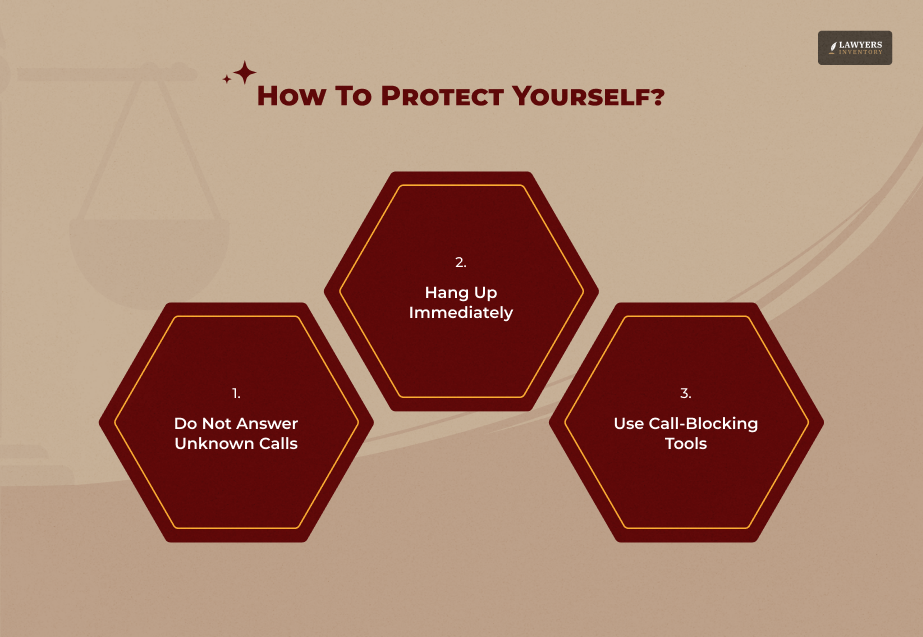
Attorneys General Robocall Warning Letters will be of no use if you don’t take these simple steps to protect yourself.
Do Not Answer Calls from Unknown Numbers
One important thing you have to remember is not to answer calls from numbers you do not know. They will leave a message if they are legit. They won’t if they are scammers.
Hang Up Immediately
As soon as you are connected, if a message or an actual rep asks you for information, you immediately hang up without pressing any buttons or saying “yes.”
Use Call-Blocking Tools
Make good use of the spam-blocking capabilities available on your cell phone operating systems. Additionally, most cell phone service providers have free or cheap call-blocking tools.
Register And Look Up At Do Not Call List
Register your phone number on do-not-call.gov.
While this will not stop international scammers from getting in touch with you, it will keep most other permitted telemarketers away.
Methods To Report A Robocall
The reporting of these calls is helpful in building a case in order to enforce warning letters to non-compliant companies concerning the attorneys general robocalls.
Submit A File With FCC
Go to the fcc.gov/com plaints page. Then, submit your complaint. The more complaints they have concerning a particular phone pattern, the faster they can resolve the problem.
Report To FTC
Go to DoNotCall.gov to submit a complaint. They keep all complaints and share them with law enforcers.
Contact Your State AG
State AG Offices have a complaint form solely for handling robocalls.
Read Also: Decaf Mix-Up: Massimo Zanetti Beverage USA Coffee Recall
What Will Happen Next And Long-Term Consequences
The warning letters from attorneys-general offices will not be the last warning. Instead, they will be a first step into an enforcement stage.
Penalties For Non-Compliant Suppliers
Those providers who do not respond to such warning letters face:
- Severe regulatory sanctions.
- Multi-million dollar civil penalties.
- Operational de-platforming.
The AG offices have the authority to sue such companies for disregarding state and federal laws concerning consumer protection.
Furthermore, they have permission from the FCC to delist providers in the Robocall Mitigation Database (RMD) referred to in FCC communications.
Of course, being delisted is a disastrous consequence. When this happens, other companies are not allowed to accept traffic from them.
Therefore, they will not have access to telecommunications in the US.
Thirteen companies have been delisted from RMD because of a warning notice in August 2025.
A Changing Scam Environment
Removing scammers successfully leads scammers to employ new schemes. Methods can include:
- Turning our attention now to SMS, or “robotexts,” which are becoming increasingly common.
- Application of advanced voice-cloning technology based on AI.
- Routing calls via international gateways, which can be traced with difficulty.
The challenge posed by these not-so-new threats will demand a change in attitude on the part of both regulators and consumers.
Leave A Reply




Owners Must Read: Nissan Class Action Lawsuit Engine Defect Explained
Read More
Understanding The Texas Roadhouse Menu Class Action
Read More
Tepezza Class Action Lawsuit Update 2025 – Hearing Damage Claims and Legal Options
Read More
Apple Siri Lawsuit Settlement Explained – Eligibility And Payouts
Read More
Torrid Discount Class Action Settlement-Your Guide To Eligibility, Benefits, And Deadlines
Read More
0 Reply
No comments yet.